Typhoon Days Off in Taiwan: 2026 Updated Suspension Standards & Worker Rights

Whenever a typhoon hits, the most common question is: “will work and school be cancelled tomorrow?” Taiwan sees at least one suspension during every typhoon season, but the decision timing, wind and rainfall thresholds, and wage rules are details most people aren’t actually clear on. This guide starts from the legal foundation and walks through every practical right and obligation you need to know.
Legal foundation: the Work and Class Suspension Operating Regulations for Natural Disasters
A typhoon day off in Taiwan isn’t an executive decision issued at a whim — it’s grounded in clear regulations. The core basis is the Operating Regulations for the Suspension of Work and Classes Due to Natural Disasters, first issued by the Executive Yuan’s Directorate-General of Personnel Administration (DGPA) in 1996 and revised multiple times since. The regulations define:
- Which natural disasters trigger work / class suspension procedures (typhoons, heavy rain, earthquakes, floods, etc.)
- Who has authority to decide (central vs local)
- The objective standards for wind and rainfall thresholds
- Timing and channels for announcement
- The principles for worker attendance and wage handling
In other words, when you see a county or city government announce a suspension, an entire regulatory process is operating behind it — not just a mayor’s personal preference. Understanding the mechanism is how you understand your rights during a typhoon.
Who decides? Sorting out the decision authority
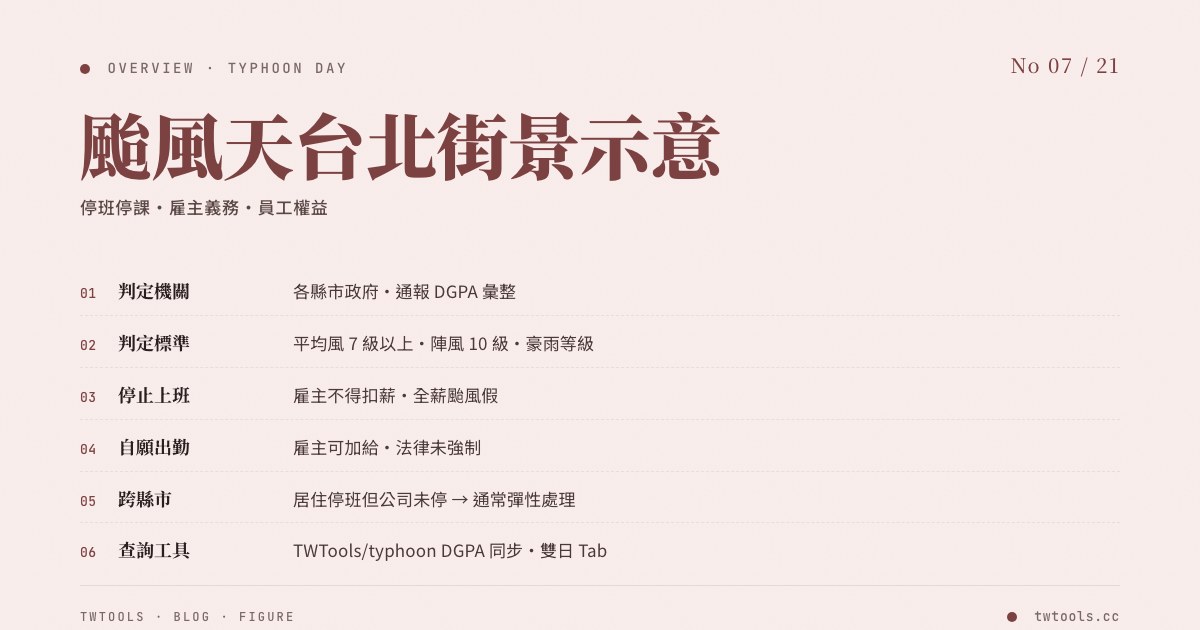
A lot of people assume work / class suspension is announced centrally — it isn’t. The decision authority rests with local mayors:
- Government agencies and schools within a special municipality: announced by the mayor of the special municipality
- Government agencies and schools within a county / city: announced by the county / city magistrate
- Governments at any level can also delegate decisions to lower-level chiefs based on terrain, geography, and disaster history (for example, mountainous townships and villages can announce independently)
That’s why you see neighboring cities sometimes split — “one calls it off, the other doesn’t.” The decision authority is decentralized, and each government independently weighs its own jurisdiction’s weather data, geography, and disaster history. Taipei City and New Taipei City may have similar rainfall but different decisions, because their mountain areas, topography, and watersheds differ.
Objective wind and rain thresholds
While the final call rests with the mayor, the Operating Regulations specify objective thresholds for wind and rain as the decision basis:
Wind threshold
Based on the Central Weather Administration’s typhoon warning forecast, for areas the typhoon’s storm-force radius is expected to cross within 4 hours, when the forecast is:
- Sustained winds at or above Beaufort scale 7 (50.4 km/h or higher), or
- Gusts at or above Beaufort scale 10 (89.4 km/h or higher)
Either condition meeting the threshold is grounds to consider suspending work and classes.
Rainfall threshold
For heavy rain scenarios, when the forecast cumulative rainfall over the next 24 hours reaches the following thresholds and damage has occurred or is imminent:
- Lowlands: 350 mm
- Mountain areas: 200 mm
⚠️ 2026 update: According to Keelung City’s announcement, the city is reportedly moving to a threshold of 200 mm regardless of mountain or lowland classification starting in 2026. The stated reasoning is that Keelung’s terrain is mostly hilly, so the original 350 mm lowland threshold no longer matched the actual disaster-prevention need. As local thresholds can change, confirm the current figure against Keelung City’s official announcement before relying on it; whether other cities will follow has not been announced.
Beaufort wind scale reference
| Wind force | Speed range (km/h) | Description | Threshold relevance |
|---|---|---|---|
| Force 7 | 50.4–61.5 | Strong wind, walking difficult | Sustained wind threshold |
| Force 8 | 61.6–74.1 | Gale, breaks branches | — |
| Force 9 | 74.2–88.5 | Strong gale, damages light structures | — |
| Force 10 | 88.6–103.8 | Storm, uproots large trees | Gust threshold |
| Force 11 | 103.9–120.0 | Violent storm, widespread damage | — |
| Force 12 | 120.1+ | Hurricane, extreme destruction | — |
When the weather anchor says “gusts at Beaufort 10 or above,” conditions are approaching the suspension threshold.
Decision timing: when does the announcement come?
City and county governments typically announce based on the typhoon’s trajectory at these times:
- Late afternoon to evening the day before (17:00–22:00): for typhoons confirmed to affect the next day, most cities announce in this window. This is the prime time office workers track most closely
- Early morning of the day (05:00–06:00): when the typhoon track shifts fast or wind and rain unexpectedly intensify overnight, an emergency announcement may come right before commute time
- Morning of the day (before 10:00): for typhoons arriving in the afternoon or progressing slowly, work / school may be suspended starting in the afternoon after the morning already started
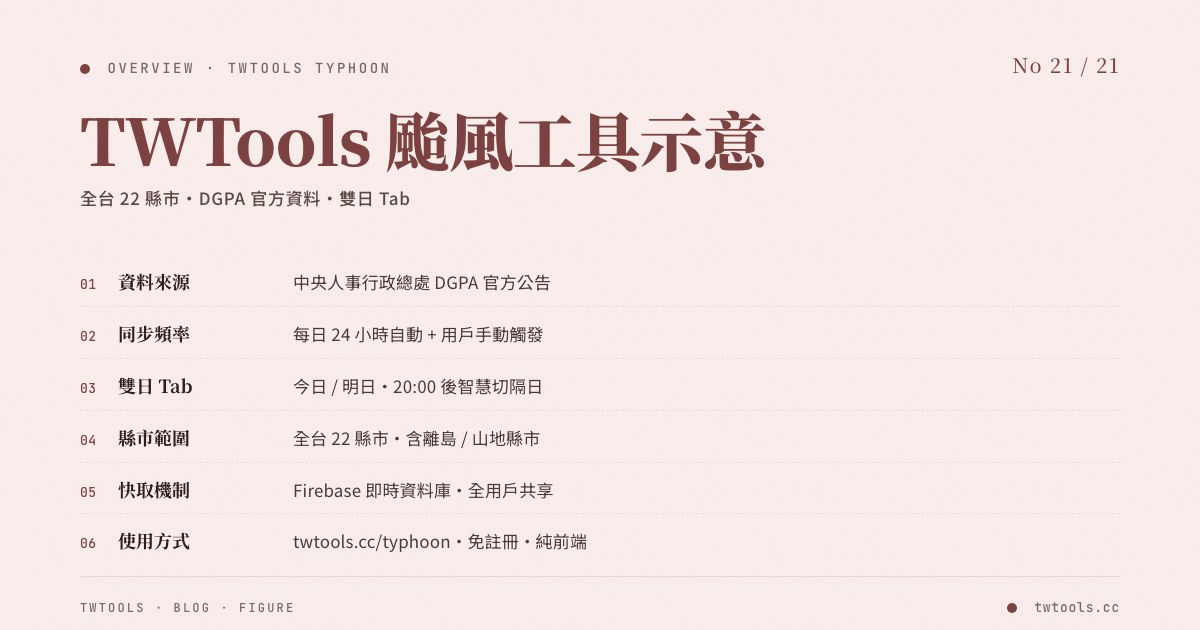
The most reliable check is the DGPA’s official “Suspension of Work and Classes for Natural Disasters” lookup page, or TWTools’ Typhoon Day-Off Lookup tool which integrates real-time status across all 22 cities and counties, saving you from hunting through each local government’s announcements.
Legal significance: is a typhoon day a “day off”? How do wages work?
The answer surprises a lot of people: legally, typhoon days aren’t categorized as “leave.” The official term is “suspension of office work or business operations at workplaces due to a natural disaster.” Per the Guidelines for Worker Attendance Management and Wage Payment when a Natural Disaster Occurs (issued by the Ministry of Labor):
Worker no-shows are not absences and not personal leave
When a typhoon suspension is announced, the employer may not treat the worker’s absence as absenteeism, nor can the employer force the worker to apply personal leave, sick leave, or annual leave to cover the day. But wage payment follows these rules:
| Situation | Worker entitlement | Employer obligation |
|---|---|---|
| Government announced suspension; worker did not attend | Not counted as absence; attendance bonus cannot be docked | Wages may be withheld (treated as “not attributable to either party”), but employers are encouraged to pay |
| Government announced suspension; worker attended (voluntarily or on request), the day was originally a normal workday | Paid for work performed | Must pay that day’s wages in full; any additional typhoon premium is advisably recommended under the Wage Guidelines (a recommendation, not mandatory, and not the same as statutory overtime pay) |
| Government announced suspension; worker attended, the day happens to fall on a rest day / mandatory day off / national holiday | Paid for work performed | Statutory overtime (holiday-work) pay applies under the Labor Standards Act (mandatory) |
| Government did not announce suspension, but the area where the worker lives, or a route they must necessarily pass through to commute, is suspended — or transit is genuinely cut off by the disaster | Not counted as absence | Same as a suspension no-show (employer “advisably should not deduct”); cannot be treated as absenteeism |
| Government did not announce suspension; transit is normal; worker chooses not to attend | Request leave per the rules | Calculated by leave category (personal leave unpaid, annual leave paid, etc.) |
| Injury or property loss while commuting | Assessed case by case as occupational injury | Employer bears occupational injury compensation responsibility |
⚠️ Two key points: First, “wages may be withheld” doesn’t mean “wages must be withheld.” A common misconception is that typhoon days are unpaid by default — actually, most companies choose to pay wages to maintain employee relations. The law gives employers flexibility, not a deduction mandate. If your company isn’t paying, you can negotiate. Second, working on a typhoon day does not automatically mean “double pay.” If the day was originally a normal workday, the employer must pay the wages for the work you performed; any additional typhoon premium is advisably recommended under the Wage Guidelines, but it is a recommendation, not mandatory — and it is not the same as statutory overtime pay. Statutory extra pay applies only when the work falls on a rest day, a mandatory day off, or a national holiday (under the Labor Standards Act).
Practical rights during a typhoon day
Treatment varies significantly by employment type. Common scenarios:
| Status | Typhoon-day situation | Watch out for |
|---|---|---|
| Office worker (general employee) | No-show is not absenteeism; attending on a day that was originally a normal workday means wages paid in full for the work performed | Any typhoon premium is advisably recommended, not mandatory; statutory overtime applies only if the day falls on a rest day / mandatory day off / national holiday. Confirm employer’s wage policy and keep attendance records |
| Student | No class on the day of suspension; school usually schedules make-up classes | Make-up may fall on a Saturday or compress winter/summer break |
| Civil servant | Treated as office day off, wages paid | — |
| Service industry (convenience stores, restaurants) | High share of staff still required to attend due to business nature | Wages for work performed must be paid in full; a typhoon premium is advisably recommended (not mandatory). If the day falls on a rest day / holiday, statutory overtime is mandatory and unpaid overtime can be reported to the Labor Bureau |
| Dispatched workers | Same Labor Standards Act protections as regular employees | Dispatch company cannot unilaterally deduct wages |
| Hourly workers | Same as employees — original shift no-show doesn’t count as absence | Wages calculated based on the originally scheduled shift |
| Self-employed (delivery riders, SOHO) | No employer relationship — Wage Guidelines protections do not apply | Personal call on whether to work; consider typhoon-day insurance |
FAQ: common typhoon-day questions
Q1: Which source has the authoritative work-suspension announcement — TV news tickers or official websites?
The DGPA’s official lookup page is authoritative. TV stations or news websites are sometimes delayed or misreport — for disputes, the official site prevails.
Q2: I went to work on a typhoon day and my boss says “no premium was paid” — what do I do?
First, separate two things. If the typhoon day was originally a normal workday, the employer must pay the wages for the work you performed — that part is required. Any additional typhoon premium is advisably recommended under the Natural Disaster Attendance and Wage Guidelines, but it is a recommendation, not mandatory, and it is not the same as statutory overtime pay. So “working during a typhoon = double pay” is a common misunderstanding. Statutory extra pay becomes mandatory only when the work falls on a rest day, a mandatory day off, or a national holiday under the Labor Standards Act — in which case unpaid statutory overtime can be reported to the local Labor Bureau. Either way, keep attendance records, time-clock logs, and conversation records with your supervisor as evidence.
Q3: How do schools make up typhoon days?
Policies vary. Most elementary through high schools schedule a full Saturday of classes or compress winter/summer break for makeups. Universities and colleges usually handle this flexibly, with each department deciding whether to make up.
Q4: What does “work suspended” vs “class suspended” mean on the DGPA’s lookup page?
“Work suspended” applies to government agencies and corporate workplaces; “class suspended” applies to schools at every level. They usually align, but exceptions happen. In some scenarios, “classes suspended but work continues” may be announced — common when wind and rain only arrive in the afternoon, allowing parents time to pick up their children early.
Q5: Are injuries from car accidents caused by downed trees or flooding during a typhoon classified as occupational injuries?
If a worker was dispatched by the employer or out for company business needs (delivery, fieldwork), an accident en route can be claimed as a commuting accident or occupational injury, with the employer bearing occupational injury compensation responsibility. After an accident, keep the police report, medical receipts, and notify the company’s occupational injury point of contact.
Conclusion: the typhoon-day standard playbook
When a typhoon is approaching, prep in this order:
- Track the weather: start watching the Central Weather Administration’s track forecast 2–3 days before landfall
- Estimate whether work will be suspended: judge the likelihood of meeting wind/rain thresholds based on when the storm radius passes through
- Monitor announcement windows: from 17:00 the day before, check the DGPA page or TWTools’ tool intensively
- Confirm employer policy: whether attendance comes with a typhoon premium (advisably recommended, not mandatory), whether the day falls on a rest day / holiday (which triggers statutory overtime), and how no-shows are handled
- Build in time: hold the go/no-go call until after the day’s suspension announcement; minimize non-essential trips during a typhoon
With the legal basis and your rights understood, a typhoon day stops being passive news-watching and becomes prepared decision-making. Check TWTools’ typhoon tool to see real-time announcements across all 22 cities and counties →
Further reading: 2026 new labor benefits — full explainer (minimum wage, parental leave, maternity subsidy) — kindred ground for typhoon-day wage rights; 2026 Labor Day overtime pay — how is it calculated? — the legal basis and worked examples for wage premiums.