2026 Taiwan Labor Reforms: Minimum Wage NT$29,500, Daily Parental Leave, NT$100K Maternity Subsidy, Hourly Family Care Leave
Starting January 1, 2026, Taiwan rolls out four major labor reforms at once: a higher minimum wage, parental leave that can be taken by the day, a unified NT$100,000 maternity subsidy per birth, and family care leave that can be requested by the hour. Each one directly affects your paycheck, family planning, and how flexibly you can take time off. This guide breaks down the legal basis, eligibility, advance-notice requirements, and the higher subsidy for twins or more — so you don’t just know the new rules exist, you know how to use them.
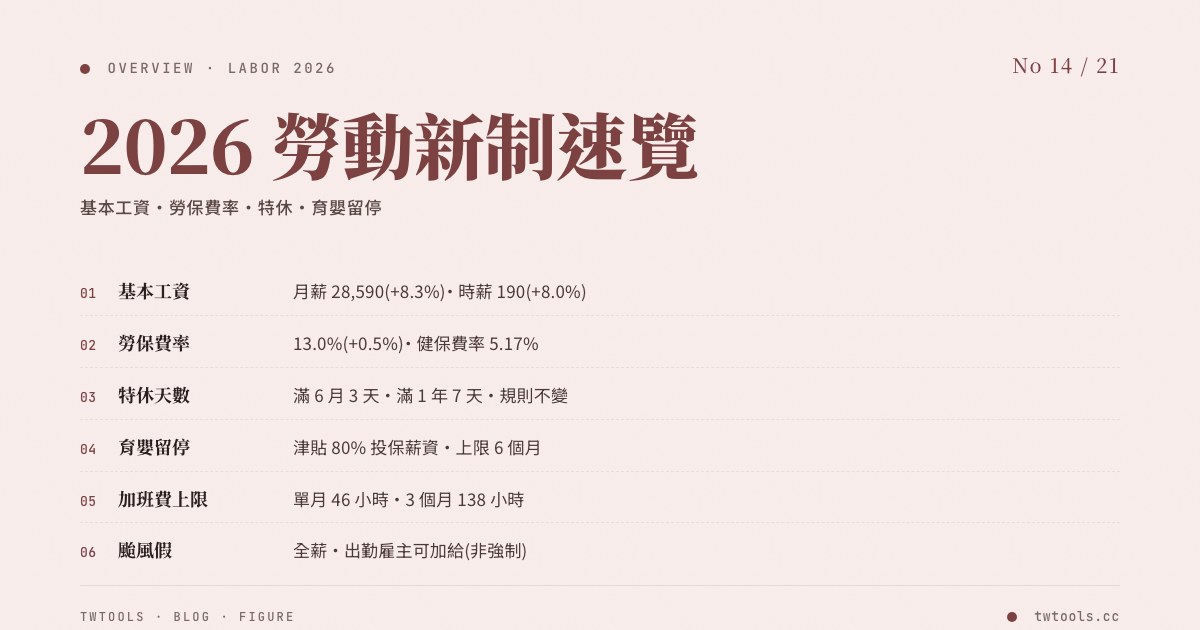
1. Quick reference: 2026 Taiwan labor reforms
| Reform | Main change | Effective date | Legal basis |
|---|---|---|---|
| Minimum wage raise | Monthly NT$28,590 → NT$29,500; hourly NT$190 → NT$196 | 2026-01-01 | Minimum Wage Act |
| Daily parental leave | Before each child turns 3, leave can be requested by the day; up to 30 days per request | 2026-01-01 | Article 16 of the Gender Equality in Employment Act |
| NT$100,000 maternity subsidy per birth | Original social insurance benefit + government top-up = NT$100,000 | Births on or after 2026-01-01 | Guidelines for Workers’ Maternity Subsidy |
| Hourly family care leave | 7 days a year = 56 hours, can be split into hours | 2026-01-01 | Article 20 of the Gender Equality in Employment Act |
A tenth consecutive raise to the minimum wage, the first time parental leave can be requested by the day, a maternity subsidy floor of NT$100,000, and family care leave that splits down to the hour — these four together are the broadest wave of Taiwan labor reform since 2024. Each is broken down below.
2. Minimum wage raised to NT$29,500 per month (NT$196 per hour)
What’s changing
- Monthly minimum wage: NT$28,590 → NT$29,500 (up NT$910, +3.18%)
- Hourly minimum wage: NT$190 → NT$196 (up NT$6, +3.16%)
- Estimated beneficiaries: about 2 million workers
- Announced: 2025-09-04 (resolution of the Ministry of Labor’s Minimum Wage Review Committee)
- Effective: January 1, 2026 (New Year’s Day)
This is the second adjustment since the Minimum Wage Act was enacted, and the tenth consecutive annual raise to the baseline wage.
How it affects your paycheck
- Salaried workers: If your monthly salary was below NT$29,500, your employer must top you up to NT$29,500 starting 2026-01-01. Otherwise they’re in breach of Article 79 of the Minimum Wage Act, and fines can reach NT$1,000,000.
- Hourly workers: If your hourly rate was below NT$196 (some service industries, part-time student workers), your employer has to make up the difference as well.
- It’s not only low earners who benefit: the Labor Insurance salary brackets and Labor Pension contribution wages are tied to the minimum wage and get bumped automatically. Your monthly Labor and Health Insurance premiums may rise NT$10–30, but your employer’s Labor Pension contribution rises too (a cumulative gap of roughly NT$1,000–2,000 a year).
3. Daily parental leave (Article 16 of the Gender Equality in Employment Act amended)
Old rule vs. new rule
- Old rule (before 2025): Unpaid parental leave had to be taken in at least one-month blocks, billed by the full month.
- New rule (from 2026-01-01): Before each child turns 3, parental leave can be requested by the day, up to 30 days per request. The total leave window can still combine up to a maximum of 2 years.
How parents share the combined 60-day allotment
Each parent gets up to 30 days that can be requested by the day (60 days combined between both). Example:
- Mom takes 5 + 10 + 15 = 30 days ✅
- Dad follows with another 20 days ✅ (50 days combined so far)
- 10 days still remain to use flexibly
Even daily leave still gets the 80% wage subsidy
From 2026-01-01, the parental leave allowance and wage subsidy are paid on a pro-rated basis. The old “anything under one month counts as a full month” rule is gone. In plain terms: request 5 days and you get 5 days of the 80% wage subsidy, with no rounding penalty.
Advance-notice requirements (by length of leave)
| Length of leave | Notice required before start |
|---|---|
| 30 days or more | 10 days in advance |
| Under 30 days | 5 days in advance |
| Emergencies (sick child, nanny unavailable, school closure) | 1 day in advance |
Who can apply?
Any worker with a child under 3. There’s no restriction by employment type — full-time, contract, and part-time workers all qualify. Employers cannot refuse (Article 21 of the Gender Equality in Employment Act).
4. NT$100,000 maternity subsidy per birth (2026 update)
How it’s structured: original benefit + government top-up
The “Expanded Maternity Subsidy Program” takes effect 2026-01-01, using a dual-track design of original insurance benefit + government top-up:
Social insurance maternity benefit + Government top-up = NT$100,000 total per birthFor example, if your Labor Insurance maternity benefit pays out NT$66,000, the government tops up the NT$34,000 difference to reach NT$100,000.
Who’s covered (not just Labor Insurance)
| Status | Original insurance benefit | Total after top-up |
|---|---|---|
| Labor Insurance insured | About NT$66,000 (depends on insured salary) | NT$100,000 |
| National Pension (homemakers, freelancers) | About NT$37,000 | NT$100,000 |
| Farmer Insurance | About NT$45,000 | NT$100,000 |
| Public Insurance (civil servants) | Per applicable rules | NT$100,000 |
| Women with no insurance coverage | 0 | NT$100,000 |
Higher subsidy for twins and beyond
The amount scales by the number of babies:
- Twins: NT$200,000 total
- Triplets: NT$300,000 total
- Quadruplets: NT$400,000 total (and so on)
How to apply: automatic, no extra form
You don’t have to submit a separate top-up application. The Bureau of Labor Insurance and the other social insurance agencies combine the calculation automatically and pay it out in one lump sum.
Payment timing
- National Pension and uninsured women: paid 2026-05-07
- Labor Insurance and Farmer Insurance: paid 2026-05-08
Stacks with local government birth allowances
The central government’s NT$100,000 is independent from local city and county birth allowances. Meet the local household registration requirements and you can receive both. For example, Taipei City adds NT$40,000 per birth, Hsinchu City adds NT$15,000. With local top-ups, some families take home more than NT$150,000 in total.
5. Family care leave by the hour (Article 20 of the Gender Equality in Employment Act amended)
From days to hours
- Old rule: Family care leave was taken by the day — up to 7 days per year.
- New rule (from 2026-01-01): Still 7 days per year, but can be split into 56 hours (7 × 8 = 56). Employers cannot refuse.
Example: take a child to the doctor from 9 a.m. to noon and you can request just 3 hours of family care leave. Under the old rule you’d have had to burn a half-day or full day, eating more leave than you actually needed.
It’s unpaid, but employers cannot dock your attendance bonus
Family care leave is unpaid — the employer isn’t required to pay wages for those hours. But under Article 21 of the Gender Equality in Employment Act:
- It cannot be counted as absence
- It cannot affect your attendance bonus, performance review, or other benefits
- Violations carry fines from NT$20,000 to NT$300,000
When it applies (sudden family care needs)
- A family member needs medical care or hospitalization
- A young child needs a vaccination
- A school closure creates last-minute care needs
- Emergency room visits or accompanying someone for medical examinations
- Covered family members include: parents, spouse, children, grandchildren, siblings, and your spouse’s parents
6. FAQ
Q1: What if my company hasn’t updated its rules for the new minimum wage, daily parental leave, or hourly family care leave?
The company is legally obligated to update its HR policies. Steps: ① raise it verbally with HR and bring up the Ministry of Labor’s announcement; ② if nothing changes within a month, file a complaint with the [1955 Labor Hotline] or your local labor affairs bureau. The burden of proving violations doesn’t fall on you — the labor bureau can launch its own inspection.
Q2: Can daily parental leave really be taken one day at a time?
Yes. For example, a mother can take 5 days starting May 1, return to work for a week, then take another 3 days — fully legal. The employer can coordinate scheduling within a reasonable scope (for example, asking you to cluster on Mondays or Fridays), but cannot refuse outright.
Q3: Can I receive the NT$100,000 maternity subsidy if I don’t have Labor Insurance?
Yes. The new program covers women with no social insurance at all — the government pays the full NT$100,000. Homemakers, students, and freelancers who give birth or deliver prematurely on or after 2026-01-01 receive the payment directly on 2026-05-07.
Q4: Are the NT$200,000 for twins or NT$300,000 for triplets paid in installments?
No. The payment goes out in a single lump sum to your designated account, calculated by the number of babies. A family with triplets receives NT$300,000 in one transfer, available immediately for the kids’ expenses.
Q5: What’s the difference between family care leave and personal leave?
Family care leave is unpaid but cannot dock your attendance bonus. Personal leave is unpaid and can affect your attendance bonus or performance review. Family care leave is limited to sudden family care needs; personal leave has no specific reason requirement. Use family care leave first — if you exceed 7 days / 56 hours, then switch to personal leave.
Conclusion
Taiwan’s 2026 labor reforms tackle three fronts in parallel: declining birth rates, worker rights, and family-friendly employment. The NT$29,500 monthly / NT$196 hourly minimum wage protects baseline income. Daily parental leave plus the 80% wage subsidy means parents no longer have to take a full month off for what’s really just a week of care. The NT$100,000 maternity subsidy combined with local top-ups lifts some of the early financial pressure of having a child. Hourly family care leave stops a half-day appointment from costing you a full day’s attendance.
One concrete step today: open your company’s HR system or ask HR whether your leave rules have been updated to the 2026 framework. If they haven’t, your employer is legally required to adjust. Share this article with the coworkers and friends around you — rights have to be claimed actively, not waited on.
Further reading: 2026 Annual Leave Guide, How Labor Day Overtime Pay Is Calculated, and the date calculator for tracking parental leave days.