2026 Taiwan Labor Day: First Year of Nationwide Holiday — Overtime Pay 2× Wages, Comp Time, and Complaint Channels

May 1 Labor Day is coming up again. 2026 is a historic year: after the 2025-05-28 amendment to the Regulations on Implementing Memorial Days and Holidays, May 1 Labor Day becomes a nationwide public holiday for the first time — civil servants, teachers, and students all get the day off (previously, only workers covered by the Labor Standards Act did). This guide covers who’s eligible, the 2× wages overtime formula, real calculations for monthly salaries of NT$30,000–60,000, the 1:1 comp-time rule, and the complaint channels and penalties when an employer breaks the law. Information current as of April 2026.
2026 Labor Day reform: from “workers only” to “nationwide”
Why the amendment passed
For years, May 1 Labor Day was a paid holiday only for “workers” covered by Article 37 of the Labor Standards Act. Students, teachers, civil servants, and others outside the labor classification still had to work on May 1 — producing the strange situation of “parents are off but the kids have school,” or “the husband is off but the wife is a civil servant and has to work.”
On May 28, 2025, the Legislative Yuan passed an amendment to the Regulations on Implementing Memorial Days and Holidays, adding 5 new nationwide public holidays: the night before Lunar New Year’s Eve, May 1 Labor Day, September 28 Confucius’s Birthday, October 25 Taiwan Retrocession Day, and December 25 Constitution Day. The new law takes full effect from 2026.
Who gets May 1, 2026 off
- Nationwide: workers, civil servants, teachers, and students (the first time it’s been unified)
- Special arrangements: police, firefighters, coast guard, and military personnel may have the day shifted to another date because of year-round shift duty — they may not necessarily be off on May 1 itself
- Financial markets: domestic bank employees take the day off, but the financial markets still open (the U.S. and Taiwan stock exchanges follow their own market-closure calendars)
- Garbage collection: per each city or county’s environmental protection bureau announcement — typically no collection on May 1
May 1, 2026 falls on a Friday, combining with Saturday (5/2) and Sunday (5/3) into a 3-day long weekend (the first nationwide 3-day Labor Day weekend in Taiwan history).
How is Labor Day overtime pay calculated? The 2× wages formula
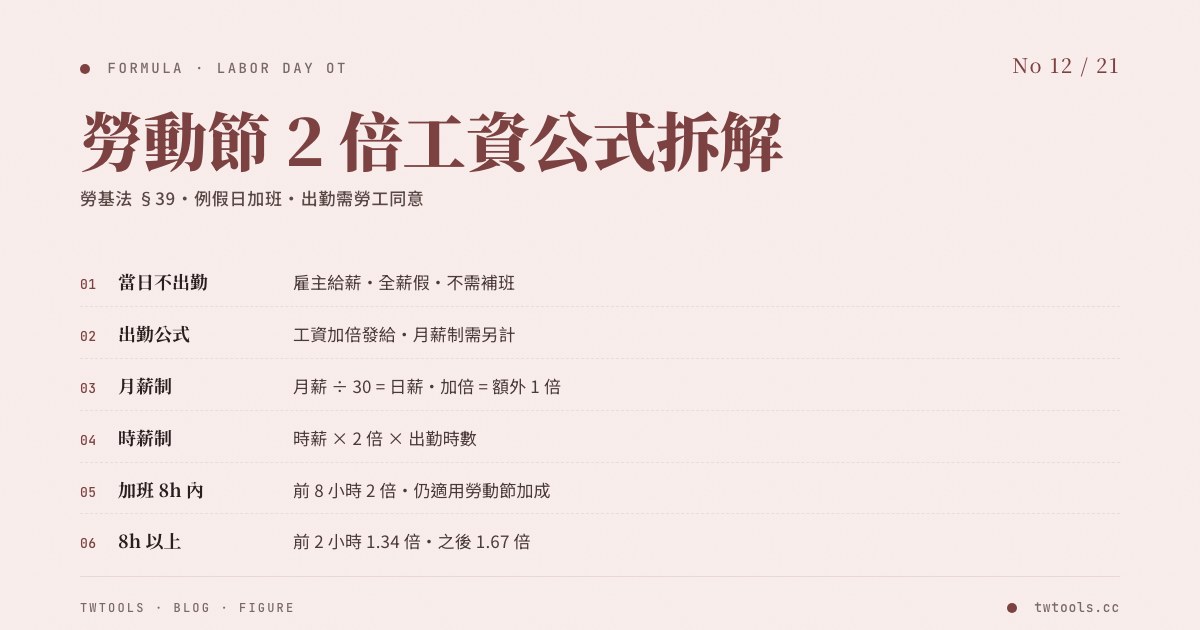
Article 39 of the Labor Standards Act states that if an employer has a worker on the job during a holiday with the worker’s consent, wages shall be doubled. “Doubled” here means “in addition to the regular day’s wages, an additional day’s wages on top” — so you actually receive 2× the daily wage.
Formula
- Monthly salary: daily wage = monthly salary ÷ 30
- Labor Day on-duty pay = monthly salary ÷ 30 × 1 (already included in your monthly salary) + monthly salary ÷ 30 × 1 (additional pay)
- Extra amount you actually receive = monthly salary ÷ 30
Note: if you work more than 8 hours on the day, the portion over 8 hours is paid at the weekday extended-overtime rate of 1.34× or 1.67×, not at 2× for the entire day.
Worked example for NT$30,000–60,000 salaries: how much are you being underpaid?
Suppose you work 8 hours on Labor Day and your boss only pays you a normal day’s wages:
| Monthly salary | Daily wage | Should be paid (additional) | Shortfall |
|---|---|---|---|
| NT$30,000 | NT$1,000 | NT$1,000 | NT$1,000 |
| NT$40,000 | NT$1,333 | NT$1,333 | NT$1,333 |
| NT$50,000 | NT$1,667 | NT$1,667 | NT$1,667 |
| NT$60,000 | NT$2,000 | NT$2,000 | NT$2,000 |
Extended calculation when overtime runs past 8 hours
If you work 10 hours that day, the additional 2 hours get extended-overtime pay on top. Using NT$40,000 monthly salary as an example:
- Hourly wage: about NT$167 (NT$40,000 ÷ 30 ÷ 8)
- First 8 hours: NT$1,333 additional pay (the “additional” portion of 2× wages)
- Hours 9–10 at 1.34×: NT$167 × 1.34 × 2 = about NT$447
- Total additional pay owed: NT$1,333 + NT$447 = about NT$1,780
If you work 12 hours (the portion past 10 hours is at 1.67×):
- Hours 9–10: 1.34 × 2 hours = NT$447
- Hours 11–12: 1.67 × 2 hours = NT$558
- Total additional pay owed: NT$1,333 + NT$447 + NT$558 = about NT$2,338
⚠️ Past 12 hours is prohibited: the legal cap is 12 hours of work in a single day (including normal hours). Employers forcing overtime beyond that are in violation.
Can the boss require comp time instead of overtime pay?
No — that’s a common misconception. Under Article 32-1 of the Labor Standards Act:
- Comp time must be the worker’s own choice — employers cannot force comp time to replace overtime pay
- The proper flow: the employer first pays the doubled wages as required by law → if the worker later prefers comp time, the two sides can negotiate
- Comp time is calculated 1:1, not 1:2 (8 hours worked = 8 hours of comp time, not 16)
- Comp time must be used within the agreed deadline; any unused balance still has to be converted into wages
A common workplace dispute is the boss saying “our company gives comp time across the board” — that violates the Labor Standards Act. Workers have the right to demand the cash payout, and if pushed back on, they can file a complaint afterward.
May 1 long weekend: make-up workdays and leave-stacking tips
May 1, 2026 falls on a Friday, so there’s no make-up workday issue (the make-up workday system was scrapped from the second half of 2025). Some companies, however, will “voluntarily” require Saturday work — that situation falls under labor-management agreements on “shifting” rest days, and must meet:
- Agreement from the union or a labor-management meeting
- Prior public notice
- Post-shift compliance with the 7-day rule (at least 1 mandatory day off every 7 days)
If you want to take Thursday (4/30) off with annual leave to stack a 5-day overseas trip, a few things to keep in mind:
- Annual leave must be requested in advance. The employer can only negotiate based on genuine business needs; they cannot refuse without reason.
- If your leave window crosses Labor Day, 5/1 doesn’t count as annual leave and isn’t deducted from your balance.
- When mapping out your trip, a countdown timer can help you confirm how many days remain in the long weekend so you can book flights and lodging accordingly.
What to do when an employer refuses to pay overtime: a 4-stage complaint process
If your boss refuses to pay Labor Day overtime, here’s the playbook:
Stage 1: Preserve evidence (do this immediately)
- Payslip (showing no additional payment)
- Attendance records (time-clock punches, sign-in sheets)
- LINE / email exchanges (the boss saying “just take comp time” or “our company doesn’t do 2×”)
- Screenshots of check-in or attendance management systems
Stage 2: Internal negotiation (lowest-cost option)
- Write a letter or ask in person for the company to reissue payment in accordance with the law
- Cite Article 39 of the Labor Standards Act
- Give the company 1–2 weeks to respond
Stage 3: Complaint channels (free)
- File with the labor affairs bureau: submit a complaint to the labor affairs bureau in the city or county where the company is located
- 1955 Labor Hotline — the national toll-free worker consultation and complaint line (the complainant’s identity is protected by law)
- Online complaint: through the e-system of the Ministry of Labor’s Institute of Labor, Occupational Safety and Health
Stage 4: Mediation or litigation
- Labor dispute mediation: file with the local labor affairs bureau (free, usually resolved within 30–45 days)
- If mediation fails → labor court litigation (you can apply to the Legal Aid Foundation for a free attorney)
Employer penalties
Employers in breach of Article 39 of the Labor Standards Act face fines of NT$20,000 to NT$1,000,000, with the business name and person in charge publicly disclosed. The complainant’s identity is protected by law, and retaliatory dismissal is illegal (if you are fired in retaliation, that’s “wrongful dismissal” and is grounds for a separate complaint).
Cross-country May 1 comparison: how the U.S., Japan, and South Korea differ
May 1 carries different historical context and meaning around the world — it’s not a public holiday everywhere. Taiwan’s 2026 shift from “workers only” to “nationwide” is actually a new milestone in alignment with the spirit of International Workers’ Day.
United States: May 1 is not Labor Day
A lot of people assume “Labor Day” is internationally standardized. In fact, the U.S. Labor Day is the first Monday in September (legislated in 1894) — the date was deliberately moved away from May 1 to avoid commemorating the 1886 Chicago Haymarket riot (which is precisely the historical origin of the May 1 International Workers’ Day). The U.S. instead designates May 1 as Loyalty Day — statutory but not a public holiday, and rarely noticed.
Japan: May 1 is part of Golden Week
May 1 in Japan isn’t a national holiday, but because it sits between Showa Day on 4/29, Constitution Memorial Day on 5/3, Greenery Day on 5/4, and Children’s Day on 5/5, most companies treat the day as special leave, letting employees enjoy a continuous 7–9 day “Golden Week (ゴールデンウィーク).” Japanese workers tend to use this day for overseas or domestic travel rather than union gatherings — a noticeably different vibe from Labor Day in Europe or Taiwan.
South Korea: just upgraded to a public holiday in March 2026
Korea’s Workers’ Day (근로자의 날) has held an unusual status since 1958: paid leave for the private sector, but civil servants still had to work. In March 2026, the South Korean National Assembly passed an amendment elevating May 1 to a nationwide public holiday, so civil servants, teachers, and students now all get the day off. The change tracks closely with Taiwan’s 2025-05-28 amendment, reflecting the broader East Asian trend in recent years toward making Labor Day a universal holiday.
Comparison summary
| Country | May 1 status | Nationwide holiday? | Key feature |
|---|---|---|---|
| Taiwan | Public holiday (from 2025-05-28) | ✅ Yes (first time in 2026) | First nationwide 3-day weekend |
| South Korea | Public holiday (from 2026-03) | ✅ Yes (from 2026) | Upgraded the same year as Taiwan |
| Japan | Golden Week (not statutory) | ⚠️ Most companies treat as special leave | 7–9 consecutive days |
| United States | Loyalty Day (statutory but not a public holiday) | ❌ No | Labor Day is in September |
As one of the few Asian countries to elevate May 1 to a public holiday in the same year as another, Taiwan’s 2026 Labor Day isn’t just a personal day off — it’s a historical moment in bringing Taiwanese worker status closer to international norms.
FAQ
Q1: I’m on a monthly salary — will Labor Day leave reduce my pay?
A: No. Labor Day is a paid holiday. Monthly-salaried employees get the day off with no salary deduction, and it doesn’t count as absence. If the company docks your pay because you weren’t at work, that violates the Labor Standards Act.
Q2: Do dispatched workers and part-time workers get paid for Labor Day?
A: Yes. As long as the Labor Standards Act applies — dispatched, part-time, or hourly — you’re entitled to Labor Day pay. Part-time workers are paid pro-rata. For example, if you’ve agreed to 4 hours a day, you should be paid for 4 hours on the holiday.
Q3: Labor Day happens to fall on my regular day off (say, a Saturday) — can I stack them?
A: You cannot stack them. If Labor Day overlaps with a mandatory day off or rest day, per the Ministry of Labor’s interpretation you “choose one and take a substitute day off.” Most employers will schedule a make-up day afterward. Confirm the substitute date with your company first.
Q4: I’m in my probation period — do I get Labor Day off?
A: Yes. Workers on probation are still covered by the Labor Standards Act, and the public holiday rights are identical. Employers cannot reduce them on grounds of “no leave during probation” — doing so is illegal.
Q5: Will civil servants really get May 1, 2026 off?
A: Yes, really. From 2025-05-28, the Regulations on Implementing Memorial Days and Holidays added Labor Day as a nationwide public holiday — civil servants, teachers, and students all take May 1, 2026 off. This is the first time Taiwan has had a nationwide 3-day Labor Day weekend. Police, firefighters, coast guard, and military personnel may have the actual day off shifted because of shift duty.
Q6: Do foreign migrant workers get Labor Day off?
A: Yes. Household caregivers and domestic helpers are also covered by the Labor Standards Act’s holiday rules, and the employer must either pay them or pay double wages as required by law. Violations can be reported to 1955 (multilingual support available).
Final reminder
2026 is a historic year for Taiwanese worker rights — Labor Day shifts from “workers only” to “nationwide.” For workers, knowing your rights is the first step; being willing to assert them is the second. If you run into a law-breaking employer, 1955 is a free channel you can use — no cost to use, complainants are protected, results are guaranteed. Wishing everyone a 3-day Labor Day weekend with family.