2026 Taiwan Summer Electricity Rates Start June 1: Correct Bracket Tiers + NT$12,000 Subsidy + 7 Saving Tips
Data current as of May 2026. Taipower’s “summer rate” runs every year from June 1 through September 30, and it’s meaningfully more expensive than the non-summer rate. For office worker households, turning on the AC alone can push June’s bill 1.5× higher than May’s. This guide pulls together the 2026 rate tiers, practical energy-saving techniques, and up to NT$12,000 in energy-saving subsidies — so you can get ready before summer arrives.
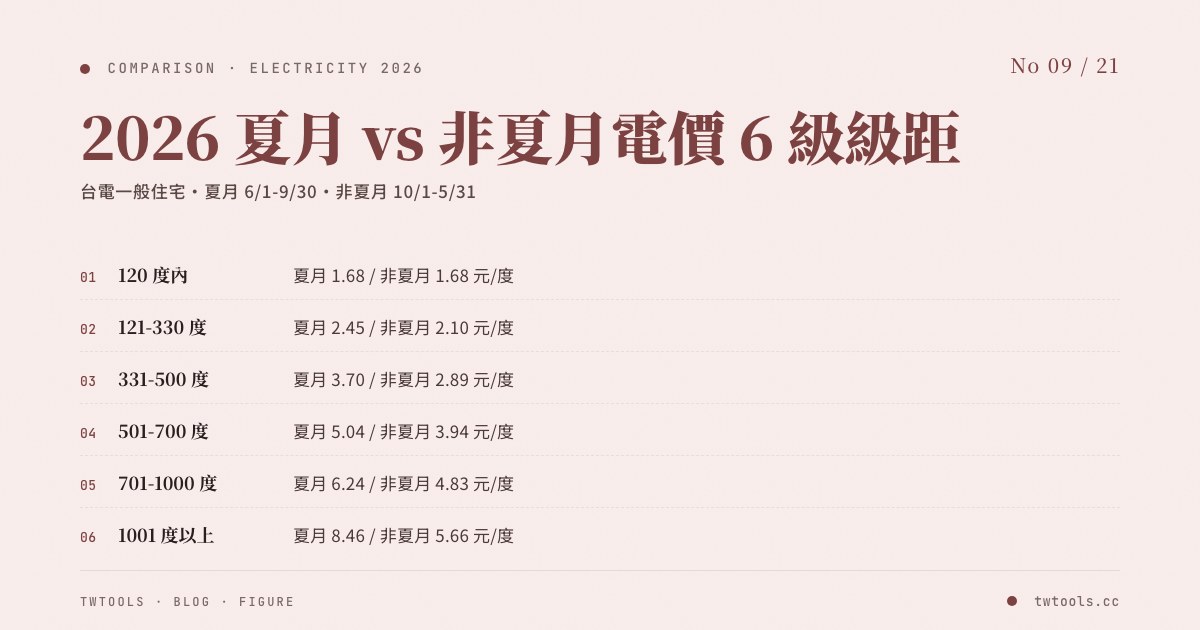
The correct 2026 summer rate tiers
A lot of older articles cite outdated prices. The latest 2026 Taipower residential rates (progressive tier system by kWh consumed):
| Monthly usage (kWh) | Summer (6/1–9/30) | Non-summer | Tier delta |
|---|---|---|---|
| 1–120 | 1.68 | 1.68 | 0 |
| 121–330 | 2.45 | 2.16 | +13% |
| 331–700 | 3.70 | 3.03 | +22% |
| 701–1000 | 5.04 | 4.14 | +22% |
| 1001–1500 | 6.24 | 5.07 | +23% |
| 1501+ | 8.46 | 6.63 | +28% |
(Rates in NT$ per kWh.)
Progressive billing: it’s not “all your electricity gets billed at the highest tier” — it’s “tiered billing.” For example, using 500 kWh: the first 120 kWh at NT$1.68, kWh 121–330 at NT$2.45, kWh 331–500 at NT$3.70.
Worked comparison: a 500-kWh household, summer vs non-summer
Say your household uses 500 kWh a month:
Non-summer bill:
- 1–120 kWh: 120 × NT$1.68 = NT$201.6
- 121–330 kWh: 210 × NT$2.16 = NT$453.6
- 331–500 kWh: 170 × NT$3.03 = NT$515.1
- Total about NT$1,170
Summer bill:
- 1–120 kWh: 120 × NT$1.68 = NT$201.6
- 121–330 kWh: 210 × NT$2.45 = NT$514.5
- 331–500 kWh: 170 × NT$3.70 = NT$629
- Total about NT$1,345
Summer runs NT$175 more than non-summer (+15%). At 700 kWh, summer runs NT$400–500 more; over 1,000 kWh, the gap widens further. The biggest savings come from cutting usage above the 331 kWh tier.
Tip 1: set AC at 26–28°C and pair with a fan
Every 1°C you raise the AC setpoint saves about 6% on electricity (Energy Administration of the Ministry of Economic Affairs). The best practice is 26–28°C with a fan running — the perceived temperature is close to 24°C, but monthly savings come to NT$200–400.
Key AC-saving practices:
- Clean the filter regularly (a dirty filter uses 10–15% more power)
- Close doors and windows, draw the curtains to block sunlight (west-facing walls in particular)
- Use “auto” mode, not “max cool”
- Don’t cycle an inverter AC on and off frequently — continuous running for 4–6 hours is more efficient
- AC unit placement should avoid west-facing walls, and the outdoor unit needs good ventilation
- Fan assist: airflow circulation lowers perceived temperature by 2–3°C
Tip 2: track down the hidden vampires of standby power
Standby power (so-called “vampire power”) accounts for about 5–10% of household electricity. The most common hidden offenders:
- Set-top boxes, Wi-Fi routers (on 24/7)
- Chargers and adapters left plugged in when you’re not home
- Microwaves and ovens with clock displays
- Standby lights on TVs, audio gear, computer monitors
- Water dispensers, smart speakers
- Printers and scanners (standby draws more power than you’d think)
Practical move: buy a “power strip with a master switch” (NT$200–500 each), and cut everything non-essential when you leave for work or head out. In practice, a typical household saves NT$100–200/month — easy payback within a year.
Tip 3: evaluate “residential time-of-use” pricing
If your household’s usage pattern is “out all day, home at night,” consider applying for Taipower’s “residential time-of-use” rate. Off-peak hours (22:30 to 07:30 the next day) can drop as low as about NT$1.96/kWh. Schedule laundry, drying, cooking, and EV charging during that window — savings start at NT$300/month.
⚠️ The math matters: use the Taipower app’s “bill calculator” to assess your last 6 months of usage before switching — otherwise you may end up paying more. Some heavy users in Taipei / New Taipei actually do better staying on the standard plan after running the numbers.
Tip 4: capture the 2026 energy subsidy + excise tax refund (up to NT$12,000)
In 2026, the Ministry of Economic Affairs’ “residential appliance trade-in” program plus the Ministry of Finance’s “excise tax reduction” run in parallel. Combined amounts:
Single AC unit: up to NT$5,000
- Energy subsidy: NT$3,000 per Energy Class 1 AC unit (Ministry of Economic Affairs, save3000.moeaea.gov.tw)
- Excise tax refund: another NT$2,000 (Ministry of Finance)
- Maximum combined: NT$5,000
Full appliance set: up to NT$12,000
Buy all four major appliances — AC, refrigerator, water heater, dehumidifier — and apply for each subsidy + refund, up to NT$12,000 combined:
| Appliance | Energy subsidy | Excise tax refund | Subtotal |
|---|---|---|---|
| Air conditioner | 3,000 | 2,000 | 5,000 |
| Refrigerator | 3,000 | 2,000 | 5,000 |
| Water heater | 1,000 | — | 1,000 |
| Dehumidifier | 1,000 | — | 1,000 |
| Total | 12,000 |
Eligibility
- Purchase appliances with the Energy Class 1 label (including Class 1 AC and refrigerators)
- Complete recycling of the old unit (obtain the Ministry of Environment’s Waste Appliance Recycling Receipt)
- The electricity service address and account match “residential, non-commercial use”
- Invoice window: purchases from early 2023 through 2026-12-31
- Application deadline: complete online application by 2027-01-31
If your AC is more than 8 years old, the old unit uses 30–40% more power than a new one — replacing it pays back in a year just from electricity savings. Each city and county may add extra subsidies (Taipei, for example, adds NT$1,000–2,000); check the Ministry of Economic Affairs’ “Energy-Saving Appliance Subsidy” official site.
Tip 5: track your monthly electricity bill
What doesn’t get measured doesn’t get improved. Recommendations:
- Monthly meter reading (using the bi-monthly bill as a baseline) — record kWh and track “monthly kWh” and “average rate per kWh” in a spreadsheet
- The Taipower app + smart meter lets you see the hourly usage curve and identify peak hours
- Compare year over year: see how this month stacks up against the same month last year
To convert quickly between kWh, watts, and kilowatt-hours, use TWTools’ unit converter. To count down to your next meter-reading day, use the date calculator paired with the countdown timer — set a reminder for every two months.
Tip 6: switch to LED bulbs + smart sockets
Many homes still use traditional bulbs or T8 fluorescent tubes. Switching to LED:
- An 8W LED replaces a 60W incandescent bulb, cutting power use by 86%
- An 18W LED tube replaces a 40W T8 fluorescent tube, cutting power use by 55%
- Average lifespan is 5–10× longer, so fewer replacements
- One LED bulb costs NT$100–300 and pays back within 6 months
Smart sockets (NT$200–500 each) let you control appliances from your phone — if you forget to turn off the AC on your way out, you can shut it off remotely.
Tip 7: batch laundry and dishwashing
A lot of people don’t realize the washing machine + dryer are hidden summer-bill killers:
- Batch the laundry: 2 full loads a week beats washing 1 garment a day, saving 50% on the washer
- Cold-water wash: 90% of clothes wash fine in cold water — heating water accounts for about 80% of a washer’s total power use
- Air-dry instead of using the dryer: in summer, clothes dry in 2–3 hours on a sunny day, saving roughly 5–10 kWh per dryer cycle
Smart meters + time-of-use rates: 2026 eligibility breakdown
Time-of-use pricing (different rates for day vs night) saves money on the bill, but it requires a smart meter at your home. Taipower’s rollout schedule: cumulative 6 million households installed by 2030 (ROC Year 119), 100% coverage by 2035 (ROC Year 124). As of end of 2025, 76,000 residential households + 137,000 small businesses are on time-of-use rates, for a total of 213,000.
You can’t actively request a smart meter right now — Taipower will only install one in two scenarios: ① you apply for the “time-of-use rate plan,” or ② your home has “renewable energy grid integration” (e.g., your own rooftop solar). Regular users wait for the 2030–2035 rollout.
Is time-of-use right for you? Quick check:
- Residential usage above 700 kWh/month + high overnight share → eligible, potential annual savings of NT$1,000–3,000
- Small business usage above 1,100 kWh/month → eligible
- Low total usage / peak usage concentrated during the day → not recommended; may actually cost more
How to apply: ① in person at a Taipower service center, ② online via the Taipower website. Run the calculation on the Taipower app for your last 6 months of bills before deciding — you can only switch once per year.
4 things to do before the end of May
The summer rate kicks in on June 1 — there’s still time to prep:
- AC inventory: schedule replacement for any AC older than 8 years and time it with the subsidy
- Master-switch power strips: route every non-essential standby device through a master-switch strip
- Time-of-use simulation: download the Taipower app and check the time-of-use simulation result
- Subsidy submission: purchase and submit before June to avoid running out of allotments (2026 subsidy quotas are limited)
Those four moves alone can save NT$1,000–3,000 across June–September.
FAQ
Q1: When does the summer rate end?
A: September 30 every year; the non-summer rate resumes October 1. But because bills span months, the bill received at the end of October may still include some summer-rate consumption.
Q2: Is it cheaper to leave AC on all day or to switch it on and off?
A: For an inverter AC, continuous operation under 4–6 hours is more efficient than cycling on and off. For a fixed-speed AC, short trips out (under 30 minutes) are also better left on. For longer absences (over 2 hours), turn it off — otherwise it’s pure waste.
Q3: Does applying for time-of-use cost anything?
A: Free to apply, but you can only switch once per year. Switching back to the original plan is also free, but there’s a cooling-off period. Run a 6-month simulation in the Taipower app before deciding.
Q4: Do heavy users get charged more?
A: Residential usage above 700 kWh/month is billed at NT$5.04/kWh in summer and NT$4.14/kWh non-summer. Above 1,000 kWh it gets more expensive still (starting at NT$6.24/kWh in summer). Keeping usage under 700 kWh avoids the top tier — multi-person households may consider applying for separate meters per unit.
Q5: How do I apply for the NT$3,000 energy subsidy?
A: ① Buy an Energy Class 1 appliance and keep the invoice, ② complete recycling of the old unit (obtain the Waste Appliance Recycling Receipt), ③ submit online at save3000.moeaea.gov.tw plus upload ID, bankbook, and electricity bill records, ④ wait for the subsidy to deposit (about 2–4 weeks).