2026 Complete Unit Conversion Guide for Taiwan: Length, Weight, Volume, Area, and Temperature with Local Units
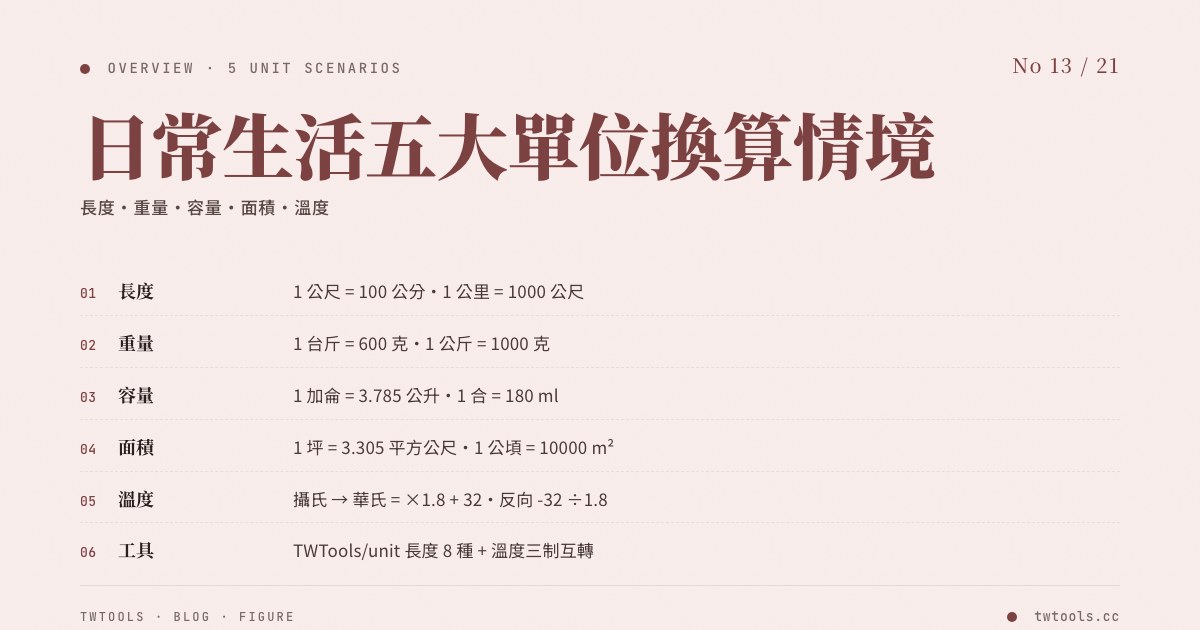
Taiwan uses the metric system day-to-day, but step out of the wet market, into a department store, or into a real-estate agent’s office and five unit systems start showing up in rotation: fruit at the market in catties, beef at the grocery store in grams, computer screens in inches, shoes in US size, apartments in pings, farmland in jia, weather in Celsius, and oven recipes in Fahrenheit. This guide pulls together five categories — length, weight, volume, area, and temperature — and lists the conversions you actually run into in daily life, plus four common-scenario quick references and five FAQs, so the next unfamiliar unit you hit has a known answer.
1. Length: switching between metric and imperial
Taiwan officially runs on metric, but buying international products quickly pulls in imperial (inch, foot, mile). Memorize these five relationships and you’ll handle 90% of daily situations.
- 1 inch = 2.54 cm
- 1 foot = 30.48 cm = 12 inches
- 1 yard = 91.44 cm = 3 feet
- 1 mile = 1.609 km
- 1 meter ≈ 3.281 feet
Buying shoes: US size 9 ≈ 27 cm (men’s). In practice each brand’s size chart differs slightly — check the brand’s official site. European sizing is roughly “foot length in cm + 33” for adult men, so EU 42 ≈ 27 cm.
Buying a screen: the inch number on a TV or monitor is the diagonal, not the width. Three useful anchors: 24” ≈ 61 cm, 27” ≈ 68 cm, 55” ≈ 140 cm.
Height conversion: 170 cm ≈ 5 feet 7 inches (5’7”). Formula: cm ÷ 30.48 = feet; the remainder × 12 = inches.
Furniture and space: in US homes, a 32” door is ≈ 81 cm, an 8-foot ceiling ≈ 244 cm, a 24” walkway ≈ 61 cm. Watch out when buying imported furniture — labels often mix inches and centimeters.
Suitcases: a “20-inch carry-on” is ≈ 51 cm, which fits most airlines’ “length + width + height ≤ 115 cm” carry-on rule. A 28” checked bag is ≈ 71 cm.
2. Weight: catties, kilograms, pounds, ounces — sorted out
Weight is the easiest category to get tangled up in. Four systems — Taiwanese catty, kilogram, pound, ounce — show up at wet markets, supermarkets, gyms, and cafés, and each spot uses something different.
The Taiwanese 16-tael system (catty)
- 1 Taiwanese catty = 600 grams = 16 taels
- 1 Taiwanese tael = 37.5 grams = 10 mace
- 1 mace = 3.75 grams
⚠️ The Taiwanese catty is a unique 600-gram standard (16-tael system), inherited from the monme weight system Japan brought during the colonial period (1895–1945): the Japanese catty was defined as 160 monme, and 1 monme = 3.75 g, so 160 × 3.75 = 600 g. China’s “market catty” is 500 grams (10-tael system) — a standard the People’s Republic of China established in its 1959 weights-and-measures reform — and it’s 100 grams lighter than the Taiwanese version. Worth keeping in mind when shopping for Chinese goods or following mainland recipes.
International units
- 1 kilogram (kg) = 1,000 grams = 2.205 pounds
- 1 pound (lb) = 453.6 grams ≈ 0.454 kg
- 1 ounce (oz) = 28.35 grams
- 1 metric ton = 1,000 kg
Wet market quick check: “Three catties of apples, please” = 1.8 kg. Half a catty of pork = 300 g (roughly one steak’s worth).
US recipe quick check: 1 lb of ground beef ≈ 454 g; 1 oz of cheese ≈ 28 g (about one slice of cheddar); 1 cup of flour ≈ 120 g (volume-to-weight varies by ingredient — flour, sugar, and butter all convert differently).
Gym quick check: a barbell plate marked 45 lb ≈ 20.4 kg; one marked 25 lb ≈ 11.3 kg. Strength-training equipment commonly mixes imperial and metric labels, so confirm the unit before counting your reps.
3. Volume: liters, gallons (US vs UK), milliliters
Volume hides a trap that’s easy to overlook — the US gallon and the UK gallon are nearly 20% apart, so mixing them up while following a recipe or filling up gas can throw the math off badly.
- 1 liter (L) = 1,000 milliliters (ml) = 1,000 cubic centimeters (cc)
- 1 US gallon = 3.785 liters (precisely 3.785411784)
- 1 UK / Imperial gallon = 4.546 liters (precisely 4.54609)
- 1 US cup (measuring cup) = 240 ml
- 1 US teaspoon (tsp) = 5 ml; 1 US tablespoon (tbsp) = 15 ml
⚠️ Where the US vs UK gallon split came from: both countries originally used Queen Anne’s gallon (3.785 L) to measure liquor. The UK’s 1824 weights-and-measures reform averaged out three different measures (wine, beer, grain) into the imperial gallon at 4.546 L; the US kept the original Queen Anne’s standard. Today, a “gallon” in the UK, Canada, or Australia is usually the imperial 4.546 L, but in the US it’s always the US 3.785 L.
US gas station quick check: a US gas price of $4/gallon = about NT$33 per US gallon = about NT$8.7 per liter (depending on the exchange rate). Useful when budgeting fuel for a rental-car trip.
US recipe quick check: 1 cup of milk = 240 ml (not 250 ml); ½ cup = 120 ml; ¼ cup = 60 ml. Taiwanese measuring cups are usually labeled in ml, so convert to ml on the spot when working from US recipes.
Water quick check: 1 liter of bottled water ≈ 33.8 US fluid ounces (a fluid ounce is volume, not weight). The “20 oz water bottle” common in US convenience stores is ≈ 591 ml.
4. Area: ping, square meter, jia, hectare, acre
Area is the unit category most likely to trip you up when buying a home — ping, square meter, and square centimeter already get mixed up, and then farmland uses jia and foreign maps use acres. It’s a lot.
- 1 ping = 3.30579 square meters (Ministry of the Interior’s exact value = 36 cai, where 1 cai = 30.3 cm × 30.3 cm)
- 1 square meter = 0.3025 ping
- 1 hectare (ha) = 10,000 square meters = 3,025 ping
- 1 jia = 0.9699 hectares = 9,699 square meters = 2,934 ping (a traditional Taiwanese land unit, commonly used for farmland transactions)
- 1 acre = 4,047 square meters ≈ 1,224 ping
Home-buying quick check: a “30 ping” apartment ≈ 99 square meters, roughly a standard two-bedroom (three rooms with double beds + living room + kitchen + bathroom). A “20 ping” unit ≈ 66 square meters, usually a one-bedroom or compact two-bedroom. The total ping on the deed includes “main building + auxiliary building + shared common area” — back out the 30%–40% common-area ratio to get the actual usable space inside.
Farmland quick check: 1 jia is just under 1 hectare (about 3% smaller). Older generations in Taiwan still buy farmland by jia. So “3 jia” ≈ 2.91 hectares ≈ 8,800 ping — that’s a sizable piece of land.
Renting quick check: a studio listed as “8 ping” ≈ 26 m², about a 5 m × 5 m space holding a bed, wardrobe, desk, and bathroom. “12 ping” ≈ 40 m² is a roomier studio or a small one-bedroom.
Tatami planning quick check: 1 tatami mat ≈ 0.5 ping ≈ 1.65 m². A “6-mat” Japanese-style room is 3 ping.
5. Temperature: Celsius, Fahrenheit, Kelvin — all in one go
Taiwanese weather forecasts use Celsius, but oven recipes, US news, and scientific papers all bring in the other two. Memorizing a formula beats trying to learn by rote.
Three scale conversion formulas
- Celsius to Fahrenheit: °F = °C × 9/5 + 32 (also written °F = °C × 1.8 + 32)
- Fahrenheit to Celsius: °C = (°F − 32) × 5/9
- Kelvin: K = °C + 273.15 (the scientific standard temperature unit; absolute zero = −273.15°C = 0 K)
Everyday temperature anchors
- 0°C / 32°F: water’s freezing point, things freeze outdoors
- 20°C / 68°F: comfortable room temperature
- 25°C / 77°F: a Taiwanese spring or autumn afternoon
- 30°C / 86°F: a Taiwanese summer outdoors
- 36.5°C / 97.7°F: normal human body temperature
- 38°C / 100.4°F: low fever threshold
- 100°C / 212°F: water’s boiling point
Cooking quick check (most ovens are labeled in Fahrenheit)
- 325°F ≈ 163°C: low and slow (cake bases, breads)
- 350°F ≈ 177°C: the standard bake (most recipes’ default)
- 400°F ≈ 204°C: medium-high (cookies, roasted vegetables)
- 450°F ≈ 232°C: high heat (pizza, crisp finishes)
Travel quick-estimate trick
For a US weather forecast, there’s a handy rough conversion: subtract 30 from the Fahrenheit reading, then divide by 2 to ballpark the Celsius value. For example, 80°F → (80 − 30) / 2 = 25°C (the exact value is 26.7°C). It’s not precise, but it’s enough to decide between a T-shirt and a jacket. In a cold snap at 20°F, the quick estimate (20 − 30) / 2 = −5°C tells you to grab the down jacket.
6. FAQ: 5 common everyday mix-ups
Q1: Is 1 Taiwanese catty the same as 1 Chinese catty?
No. In Taiwan, 1 catty = 600 g (the 16-tael system inherited from the Japanese colonial era). In China, 1 market catty = 500 g (10-tael system, reformed in 1959). Following a mainland recipe that calls for “2 catties of pork” and buying that much by Taiwanese measure means picking up 200 g more than the recipe wants.
Q2: How much steak is “16 oz” on a US restaurant menu?
About 454 g (1 oz = 28.35 g; 16 oz = 1 lb). For Asian appetites that’s a big portion — consider sharing between two people, or going for 8 oz / 12 oz instead.
Q3: How big is “30 ping” on a real estate listing?
The deed area of 30 ping ≈ 99 m², but the actual usable area depends on the “common-area ratio.” Newer buildings often have a 30%–40% common-area ratio — back out 35% from 30 ping and the indoor area is roughly 19.5 ping ≈ 64 m², a standard two-bedroom-and-living-room layout.
Q4: What’s the Celsius setting for an oven recipe that calls for “350°F”?
About 177°C (precisely 176.67°C). Oven dials usually move in 5°C increments — 175°C or 180°C both work fine. Similarly, 400°F ≈ 200°C (precisely 204°C).
Q5: Is “5 mph” on a treadmill fast?
About 8 km/h (1 mph = 1.609 km/h) — that’s a jogging pace, roughly a 7:30/km tempo. 10 mph ≈ 16 km/h, which is into the “fast running” range (front-pack marathon speed).
Wrap-up: precise math goes to the tool, common sense to the cheat sheet
A cheat sheet of common conversions handles most everyday needs, but when you need precise values for renovation materials, cooking classes, or recipe ratios, run the math through a tool. TWTools’ Unit Converter covers every unit in this article’s five categories — enter a number, get the conversion instantly, and skip the manual arithmetic. The same tool handles area conversion if you need to switch between ping, square meters, and jia.
For temperature lookups, you’ll also see Celsius and Fahrenheit side by side when checking warnings on TWTools’ Typhoon Day Off Check. Heading abroad? Note down the local Celsius range for the season in advance and pair it with the table above to dress appropriately.