The Hidden Subscription Monster: A 2026 Subscription Audit Checklist to Save NT$20,000 a Year

How long has it been since you opened that app — but the charge still hits your card every month?
2026 is the year subscription inflation hit hard, all at once. Netflix raised the Standard plan from NT$330 to NT$380 in November 2024. Microsoft 365 Personal jumped from NT$2,190 to NT$3,090 per year (+41%). YouTube Premium, Spotify, and Apple Music all raised prices in turn. For Taiwanese office workers, “the service I subscribe to went up again” has become a quarterly news cycle.
Surveys show the average Taiwanese office worker is paying for 6–8 subscriptions a month, often totaling over NT$2,000 — but more than 30% of those subscriptions sit unused. These “zombie subscriptions” quietly become fixed monthly costs, totaling NT$10,000–20,000 in wasted spending per year. The most frustrating part: the money is scattered across credit card statements and telecom bills, making the total impossible to see at a glance.
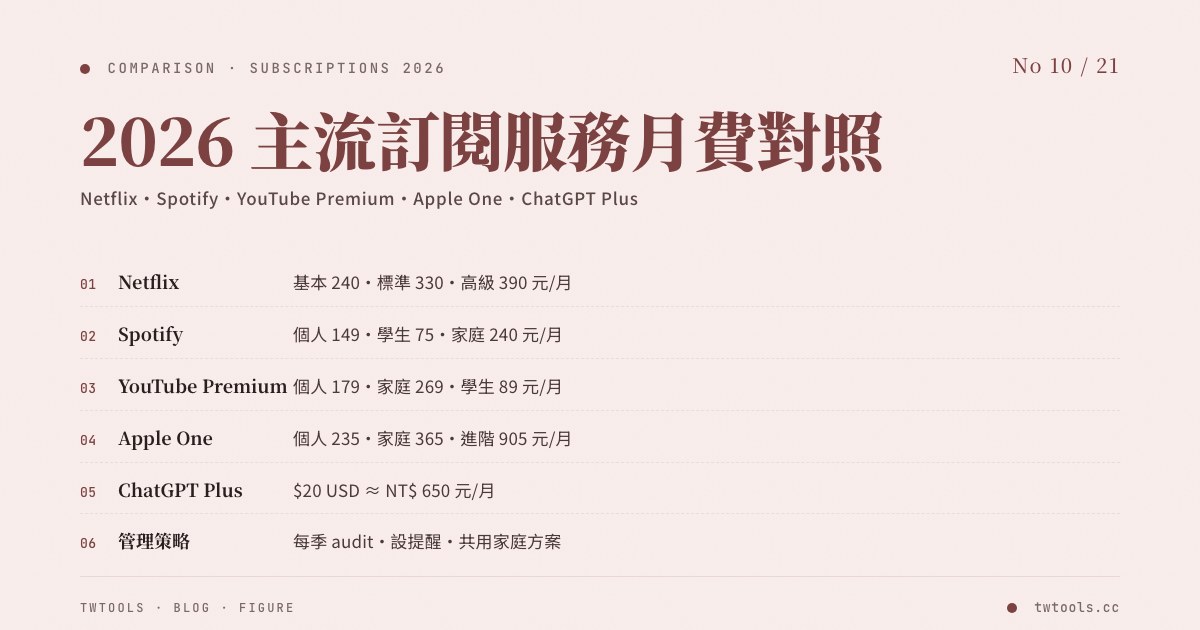
2026 subscription inflation: the numbers you need to know
Before tidying up your subscriptions, here’s the official monthly pricing for mainstream services in Taiwan in 2026. This table is the foundation for all the decisions below.
| Service | Individual plan | Family / couple plan | Student plan | Notes |
|---|---|---|---|---|
| Netflix Basic / Standard / Premium | 290 / 380 / 460 | (multi-device included) | — | Raised 2024-11 |
| Spotify Premium | 168 | Duo 228 / Family 298 | 88 | Family up to 6, requires address verification |
| Apple Music | 165 | Family 265 | 90 | Family up to 6 |
| YouTube Premium (Android / Web) | 199 | Family 399 | 119 | iOS rises to 260 due to App Store fee |
| Disney+ | Monthly 285 / Yearly 2,790 | Premium monthly 335 / yearly 3,280 | — | Premium supports 4K + HDR + 4 devices |
| Microsoft 365 Personal / Family | 3,090/year | 4,190/year (6 people) | — | Big jump in 2024-11 with Copilot |
| iCloud+ 50 GB / 200 GB / 2 TB | 30 / 90 / 300 | (family sharing included) | — | Family sharing from 200 GB up |
(All prices in NT$ per month unless noted.)
⚠️ Note: iOS in-app purchases carry a 30% Apple-tax markup, so subscribing to YouTube Premium from an iPhone costs NT$60 more than from a computer or Android device. For any subscription that supports multiple platforms, subscribe from a computer or Android device and then sign in on the iPhone.
Step 1: take a full inventory of your subscriptions
Open your credit card statement and phone bill, and identify every recurring charge. The easiest one to miss is telecom bill bundling — Chunghwa Telecom, Taiwan Mobile, and Far EasTone bundle Netflix and Disney+ into the monthly bill, and users routinely forget to count them.
Organize the list into these categories:
- Streaming entertainment: Netflix, Disney+, Apple TV+, Hami Video, myVideo
- Music: Spotify, Apple Music, KKBOX, YouTube Music
- Cloud storage: iCloud+, Google One, OneDrive, Dropbox
- Productivity: Microsoft 365, Google Workspace, Notion Plus, Adobe Creative Cloud
- AI tools: ChatGPT Plus, Claude Pro, Perplexity Pro, Gemini Advanced
- Fitness: gym monthly membership, yoga apps (Down Dog, Nike Training Club Pro), sports watch subscriptions
- VPN / security: NordVPN, ExpressVPN, antivirus software
- Other: Switch Online, PS Plus, e-books (Kindle Unlimited, Hami Bookstore), online courses
Many people are surprised to discover “I have 12 subscriptions?” — and 5 of them you don’t even remember signing up for, or signed up for a one-off event and forgot to cancel.
Step 2: assess actual usage of every subscription
Ask yourself four questions about each one:
- How many times have I actually opened it in the past 30 days? (Not how many times you wanted to use it — how many times you actually did.)
- If I cancel, will it really affect my daily life?
- Is there a cheaper alternative (free tier, family plan, annual subscription discount)?
- Can I share with family or friends to lower the cost?
A few 2026 real-world examples:
- Netflix Standard at NT$380: worth it if you watch 3+ times a week; if you watch less than 5 times a month, switch to free YouTube content or share a family member’s account (must be the same address to comply)
- Microsoft 365 Personal at NT$3,090/year: if you only use Word + Excel, free Google Docs / Sheets are sufficient. If the whole household needs Office + 1 TB cloud, the Family plan at NT$4,190/year split 6 ways is NT$698/year per person — way cheaper than the Personal plan
- Apple Music Personal at NT$165: switch to Family at NT$265/month ÷ 6 people = NT$44 per person, dramatically less than Personal
- YouTube Premium Personal at NT$199: worth it for heavy ad-watchers + people who listen to videos in the background (ad-free) + YouTube Music in one bundle. Light users can block ads with Brave + an ad blocker (with some limits on mobile)
Step 3: run a “subscription cooling-off period”
If a subscription has gone unused for 30+ days, cancel it and see what happens. Most services preserve your account and settings for 90–180 days, so re-subscribing is two clicks away — but the 30-day “vacuum period” reveals whether you actually need it.
How to do it:
- On your phone calendar, mark each subscription’s next billing date
- Three days before each billing date, remind yourself — check whether you actually used it this month
- If you didn’t use it, cancel outright (don’t “try one more month” — the self-deception extends to month 3 and 4)
- 30 days post-cancellation, ask yourself: “did I miss it?” If not, that’s permanent
Step 4: family plans — actual savings broken down per person
Some subscriptions support family plans, but they require same-address verification (Spotify started checking in 2023, Netflix followed in 2024). If you share with family or housemates (roommates, partner), per-person cost can drop to 1/3 to 1/6 of standalone:
| Service | Personal | Family plan | Per person (6 / 4) | Monthly savings per person |
|---|---|---|---|---|
| Spotify | 168 | 298 | 50 (6 people) | 118 |
| Apple Music | 165 | 265 | 44 (6 people) | 121 |
| YouTube Premium (Android) | 199 | 399 | 67 (6 people) | 132 |
| Microsoft 365 | 3,090/year | 4,190/year | 698/year (6 people) | 199/month |
| iCloud+ 200 GB | 90 | 90 | 22.5 (4 people) | 67.5 |
⚠️ Family plans aren’t just “find friends to split it” — the service uses IP address, geolocation, and Wi-Fi name to determine whether you actually live together. Netflix has started charging “extra household fees” (NT$100/month per additional household) to cross-address users. The safest family-plan participants are real cohabiting family members or roommates.
Step 5: regular audits (once per quarter)
Don’t assume “audit once and you’re done.” Three months later, you may have signed up for new services (a limited-time deal), or forgotten a yearly subscription is about to renew. Reserve 15 minutes per quarter (every 3 months) to:
- Reopen credit card and telecom bills
- Compare against your list — any new “unrecorded charges”?
- For yearly subscriptions about to expire — decide on renewal, set a reminder 3 days before expiration
- Check which 2026 services have raised prices and assess downgrading or cancelling
Worked example: a 2026 before-and-after subscription cleanup
Before, monthly spend:
- Netflix Standard 380 + Spotify Personal 168 + iCloud+ 200 GB 90 + Microsoft 365 Personal 258 (3,090÷12) + YouTube Premium Personal 199 + Notion Plus about 320 (US$10 × 32) + online courses 500 + gym 1,500 = monthly NT$3,415
After the audit:
- Netflix → share account with sibling (same address) → split in half = 190
- Spotify → Family plan, 6-person split (whole family listens) → 50
- iCloud+ → Family Sharing 200 GB → 22.5
- Microsoft 365 → Family plan 4,190/year ÷ 6 people ÷ 12 months → 58
- YouTube Premium → Family plan Android → 67
- Notion Plus → cancel (free version is enough for personal use) → 0
- Online courses → no annual subscription, buy individually as needed → average 150
- Gym → swap for YouTube workouts + occasional drop-in passes → 500
- Monthly NT$1,037, monthly savings NT$2,378, annual savings NT$28,536
The point isn’t to cut every subscription — it’s to make every dollar match real value. The extra NT$28,536 per year goes into an emergency fund, a yearly travel fund, or a regular 0050 ETF auto-buy.
Long-term strategy for the subscription-inflation era
The 2024–2026 subscription inflation cycle tells us: “affordable now” doesn’t mean “affordable next year”. Any service may raise prices by 10–40% without warning in any given November. The long-term coping strategy:
- Cap on per-service monthly fee: set your own standard (e.g., “no single subscription exceeds 0.5% of monthly salary”) — anything over the cap triggers a review
- Annualize the math: multiply monthly × 12 to see the yearly cost. “Spotify NT$2,016/year” hits differently from “NT$168/month”
- Substitute awareness: if Spotify hikes, try KKBOX or Apple Music; if Netflix hikes, try Disney+; no subscription is “irreplaceable”
- Family plan first: for any service that supports splitting, default to the family plan — only use Personal plans when there’s no other option
How to unsubscribe from major services
The real reason a lot of people don’t cancel: “I can’t find the cancel button” — providers deliberately bury the workflow. Cancellation paths for 2026 mainstream services:
| Service | Cancellation path | Notes |
|---|---|---|
| Netflix | Account → Account Settings → Cancel Membership | Service continues until the end of the current billing period |
| Spotify | Account → Subscription Plan → Cancel Premium | Free tier still works for logged-in listening |
| YouTube Premium | YouTube Settings → Purchases and Memberships → Manage | On iOS, cancel via App Store, not the YouTube app |
| Apple Music / iCloud+ | Settings → Apple ID → Subscriptions → Cancel Subscription | All Apple ecosystem subscriptions live here |
| Microsoft 365 | account.microsoft.com → Services & Subscriptions → Manage | Turn off “Auto-renew” first |
| Disney+ | Account → Subscription Plan → Cancel Subscription | Telecom-bundled subscriptions must be cancelled via the telecom site |
| Telecom bundling (Chunghwa / Taiwan Mobile / Far EasTone) | Mobile number management → Value-added Services → Cancel | Cancelling from the original platform may not take effect |
⚠️ The telecom-bundling trap: many people fail to cancel via the Netflix app because the subscription is actually tied to a Chunghwa Telecom bill — you have to go back to the Chunghwa Telecom site to cancel for real. How to verify: check which company billed you last month.
A “48-hour cool-down list” before adding new subscriptions
Many subscriptions are impulse adds (a limited-time offer, a friend’s recommendation, a one-time need). Set up a “48-hour cool-down list”:
- When you see a service you want to subscribe to, write it down — don’t subscribe immediately
- Reassess after 48 hours:
- How many times did I think about it in those 48 hours?
- Does an existing subscription already cover the same need?
- Is the monthly fee × 12 actually worth the annual cost?
- Will I use it for 3 months or 12 months?
- Still want it → subscribe. Forgot about it → don’t.
The 48-hour delay alone blocks 60–70% of impulse subscriptions.
Take action: open your credit card statement, spend 15 minutes listing every subscription, and ask: “am I actually using this?” The annual savings can buy a new phone, build a travel fund, or pay for an annual health checkup.