2026 Taiwan Resume Guide: Format, ATS Screening Survival, and AI Tools
In Taiwan’s job market, a recruiter spends an average of 6–10 seconds scanning a resume. But the bigger question is whether your resume reaches a recruiter at all. The 2025–2026 reality: more than 85% of Taiwan’s top-100 companies have introduced AI-assisted resume screening (ATS). Pass the ATS first, then get noticed by a recruiter — that’s the two-stage battlefield of 2026 job hunting. This guide tells you how to write a Taiwan resume in 2026 from both perspectives.
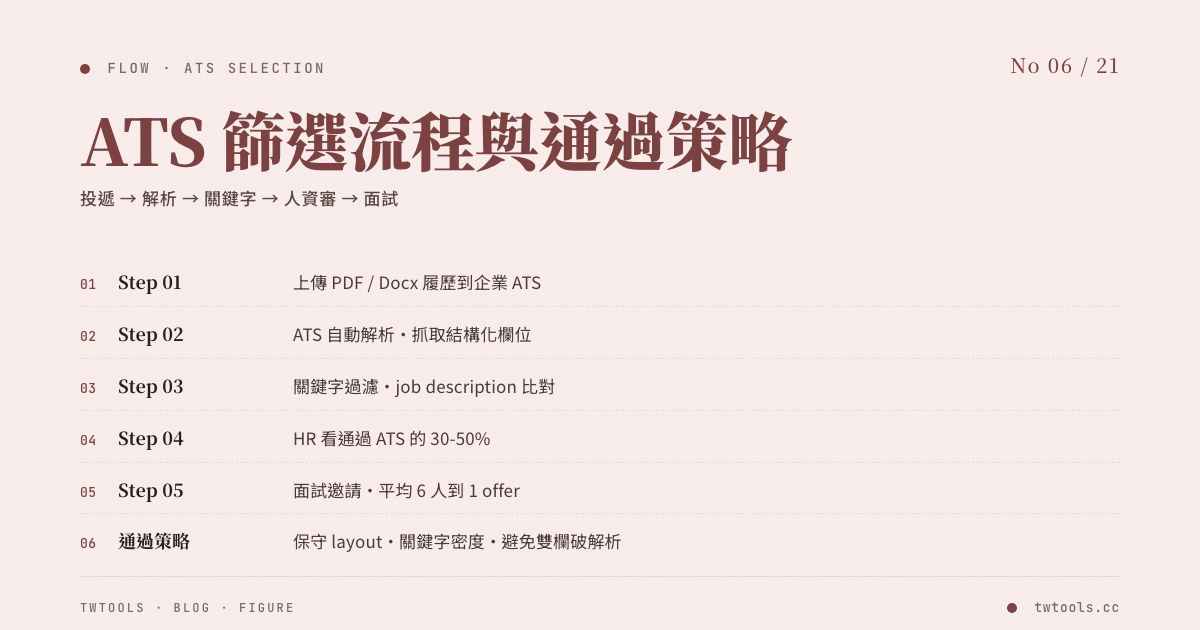
The two gates of a 2026 Taiwan resume: ATS + HR
In the past, you only had to worry about the recruiter’s reading experience. In 2026, you first have to clear ATS (Applicant Tracking System):
- ATS stage: an AI system parses your resume text, compares it to the job description (JD), and calculates a match score
- HR stage: a human recruiter decides “worth interviewing?” within 6–10 seconds
The two stages care about different things — ATS focuses on “keyword density and skills alignment”; recruiters focus on “specific outcomes and first impressions.” Nailing both is the path to an interview.
ATS-friendly design: keywords, structure, format
By 2026, Taiwan’s ATS systems have evolved beyond simple keyword matching — they now analyze the logical link between the implicit pain points in the JD and the experience you describe. But the fundamentals still matter:
Keyword optimization strategy
- Read the JD word by word: copy the job description into a text doc and circle every noun and verb (skills, tools, industry terms)
- Use the exact wording: if the JD says “Python,” use “Python” — don’t write “programming.” If the JD uses “Agile,” write “Agile” — don’t substitute “agile development” (unless the JD uses that too)
- Repeat moderately: important keywords should appear once each in “skills,” “work experience,” and “personal statement” — but don’t pile them on
- Mind the abbreviation trap: write “Human Resources” and “HR” both in full at least once, the same with “Sales” and any other paired abbreviation — ATS doesn’t always map them automatically
ATS-friendly formatting
- PDF: most ATS systems handle PDF parsing fine, but complex layouts (2 columns, text boxes, nested tables) break parsers. Stick to single column and simple tables
- Fonts: use standard fonts (Noto Sans CJK, Source Han Sans, Arial, Calibri) — avoid custom fonts
- Filename:
Name-Role-2026.pdf(e.g.Wang-XiaoMing-Marketing-Specialist-2026.pdf) — don’t useresume-final-final.pdf - No image-only resumes: a resume saved as an image (JPG/PNG) is unparseable by ATS = automatic 0 score = instant elimination
The Taiwan resume basic format
Different from the European/US market, a Taiwan resume usually includes:
- Photo: Taiwanese companies generally value first impressions, and including a formal headshot is standard (European and US markets usually omit photos to avoid discrimination)
- Basic information: name, date of birth, contact info, current city
- Education: starting from the highest degree, mostly university and above
- Work experience: reverse chronological order, most recent first
- Skills: software, languages, certifications
- Personal statement: brief self-introduction and motivation (100–200 words)
When submitting through platforms like 104, 1111, Cake, or Yourator, the system auto-formats to platform specs. For custom direct submissions, use PDF, A4, single page as a default — most recruiters don’t have the patience to flip to page 2 (the exception is candidates with 5+ years of senior experience).
The five things recruiters care about most
1. Quantified outcomes in work experience
“Responsible for social media management” sounds vague. But “during my tenure, grew Instagram followers from 5,000 to 125,000 (+150%), lifted average monthly engagement rate by 45%, and drove a +30% increase in in-store visits” immediately demonstrates value.
What recruiters want to see are specific numbers: growth percentages, projects shipped, costs saved, team size led, users impacted. An achievement without numbers is, from a recruiter’s perspective, an achievement that didn’t happen.
2. Match between your skills and the role
Read the JD carefully and identify the 3–5 skills the company specifically highlights, then make sure those appear clearly on your resume. If the role requires “Python and SQL,” don’t just say “familiar with programming” — you’ll get filtered out at the ATS stage.
3. Clean layout
Consistent fonts, comfortable line spacing, uniform margins — these details directly shape a recruiter’s judgment of your professionalism. Use Google Docs, a Word template, or a dedicated online resume tool (recommendation later) to keep the formatting stable.
4. Don’t let the personal statement read like a diary
“My name is Wang Xiao-ming. I was born in Taipei. My parents have always been supportive…” That kind of statement does nothing for the recruiter. The personal statement should answer: “why am I a fit for this role? what unique value do I bring?” Keep it under 100–200 words, tailored per role.
5. Customization matters
Don’t send the same resume to 10 different postings. Adjust the personal statement and the order of skills based on each JD — that signals to the recruiter you actually studied the role. It boosts your callback rate and is a basic act of respect for the company.
Must-use AI resume tools in 2026
A new generation of AI tools makes “customizing every resume” go from tedious to feasible:
| Tool | What it does | Pricing |
|---|---|---|
| Cake Resume Health Check | AI flags resume weaknesses + suggests rewrites + ATS simulation | Free |
| 104 Resume Health Check | Built into 104, optimized for the Taiwan market | Free for 104 members |
| JobScan | Compares your resume against a JD, gives a match score + missing keywords | Free with daily limit |
| Resume Worded | LinkedIn profile + resume dual scoring | Partial free tier |
| ChatGPT / Claude | Rewriting for quantification, polishing personal statements, English translation | Free tier sufficient |
⚠️ The limit of AI tools: AI can sharpen wording, fill in keywords, and catch logical gaps — but it can’t add experiences you don’t have. Better to write honestly about what you actually did and use AI to make it shine, than to let AI “beautify” things that didn’t happen.
LinkedIn profile: the hidden ticket for senior roles
In 2026, 60–70% of mid-to-senior Taiwan roles (NT$1M+ annual salary) are sourced through LinkedIn and headhunters. Beyond the resume, a complete LinkedIn profile is required:
- Profile photo: same as on the resume — don’t use travel photos
- Headline: title + domain keywords (e.g., “Senior Marketing Manager | B2B SaaS | Data-Driven Marketing”)
- Experience descriptions: aligned with the resume, but more detailed
- Skills endorsements: ask colleagues for mutual endorsements — having 3+ endorsements on your key skills helps you surface in headhunter searches
- Recommendations: 2–3 recommendations from past managers or clients meaningfully boost credibility
Common fatal mistakes
Typos and inconsistent formatting
The most basic mistake, and the most common. A resume with typos goes straight onto the rejection pile. Checklist: mixing of Traditional and Simplified Chinese characters, inconsistent full-width / half-width symbols, misspelled company names, punctuation placement. Read it through 3 times, ask a friend to look it over, or use the spell checker in Word / Google Docs.
Personal statement too long or wandering
Recruiters spend an average of about 30 seconds on the personal statement — anything over 500 words makes them give up. Condense the key points and write in short sentences. You don’t have to narrate your whole life story; just cover “professional background” and “why this role.”
Salary expectations stated poorly
Too specific (“monthly salary 50,000”) is an easy way to get filtered out; too low reads as unprofessional. Better to write “negotiable” or “based on the company’s salary structure” and discuss in the interview. If you must give a number, give a range (e.g., “NT$45,000–55,000”) rather than a single figure.
Padding with unrelated experience
Applying for a marketing manager role while writing at length about high-school part-time convenience store work dilutes your professional image. Lead with the most relevant work experience; older stuff gets summarized briefly or dropped. One-page resume real estate is precious — save it for the content most likely to persuade the recruiter.
Unprofessional photo
Selfies, travel photos, group shots with pets — none of them work. Spend NT$500–1,000 on a professional headshot studio for one proper formal portrait; it’ll last you 5–10 years.
Resume differences by industry
Tech: GitHub account, personal portfolio, and open-source contributions are practically required. Beyond polished writing, companies care most about technical chops and recent projects.
Marketing: data and case studies rule. Spell out the size of ad budgets you’ve managed, conversion rate gains, and the impact of the strategies you ran. Side projects (a personal Instagram, blog, or newsletter) score points.
Design: the portfolio link is critical and belongs in the most prominent spot on the resume. The work talks; the text is secondary. Behance, Dribbble, or a personal site showcase design ability better than Cake alone.
Finance: relevant certifications come first (CFA, special exams, the three finance licenses); academic background and internship experience also weigh in. Domestic and multinational firms both value a complete LinkedIn presence.
Career transition (jumping from industry A to industry B): the resume should emphasize transferable skills — what you learned in industry A that applies directly to industry B. For example, sales → product management would highlight user insight, cross-team collaboration, and data analysis — capabilities common to both worlds.
Resume building tools
If layout isn’t your strength, or you want to quickly produce a polished PDF resume, online tools help. TWTools’ Resume Generator ships with multiple templates tuned for the Taiwan job market, supports real-time editing, one-click PDF export, keeps formatting consistent, and is designed to clear ATS-friendly checks.
A final reminder: a resume’s job is to get you into the interview — the interview itself is where you actually show who you are. Spending 2–3 hours writing a strong resume gets you the foot in the door. Compared with the time investment of interviews, trial work, and onboarding that follow, this is the highest-ROI investment in your job search.