Is Voluntary 6% Labor Pension Self-Contribution Worth It? A 2026 Update Guide for NT$40K-150K Workers

Every time the payslip lands and you see the deduction line, the question pops up: “Is the 6% voluntary Labor Pension contribution actually worth it? I take home NT$2,400 less each month — does that really pay off by the time I retire?”
This guide uses the latest 2026 numbers to settle the question for workers earning NT$30,000 to NT$150,000 a month: how the Labor Pension (new system) works, the three big advantages of voluntary contribution, the actual tax savings, and who should sign up immediately versus who should hold off. Information current as of March 2026.
What is the Labor Pension (new system)? Employer 6% vs. personal 6%
Start with the basics: the Labor Pension (new system, in force since July 2005) and Labor Insurance are two completely separate retirement systems.
| System | Type | Contribution source | How you receive it |
|---|---|---|---|
| Labor Insurance | Old-age annuity, generational mutual support | Worker + employer + government share by ratio | Monthly pension / lump sum |
| Labor Pension (new system) | Individual account, yours permanently | Employer mandatory contribution of 6% of salary (worker can voluntarily add 0–6%) | Lump sum or monthly payment after age 60 |
Key point: the money in your Labor Pension individual account travels with you when you change jobs — it’s tied to your national ID number, not your employer.
So what is “voluntary contribution”? It’s the worker adding another 0–6% of salary into the same individual account. The employer’s mandatory 6% doesn’t shrink by a single cent — the voluntary portion comes out of your salary on top of that. In effect, you’re saving yourself an extra pension, with tax savings and a guaranteed return on top.
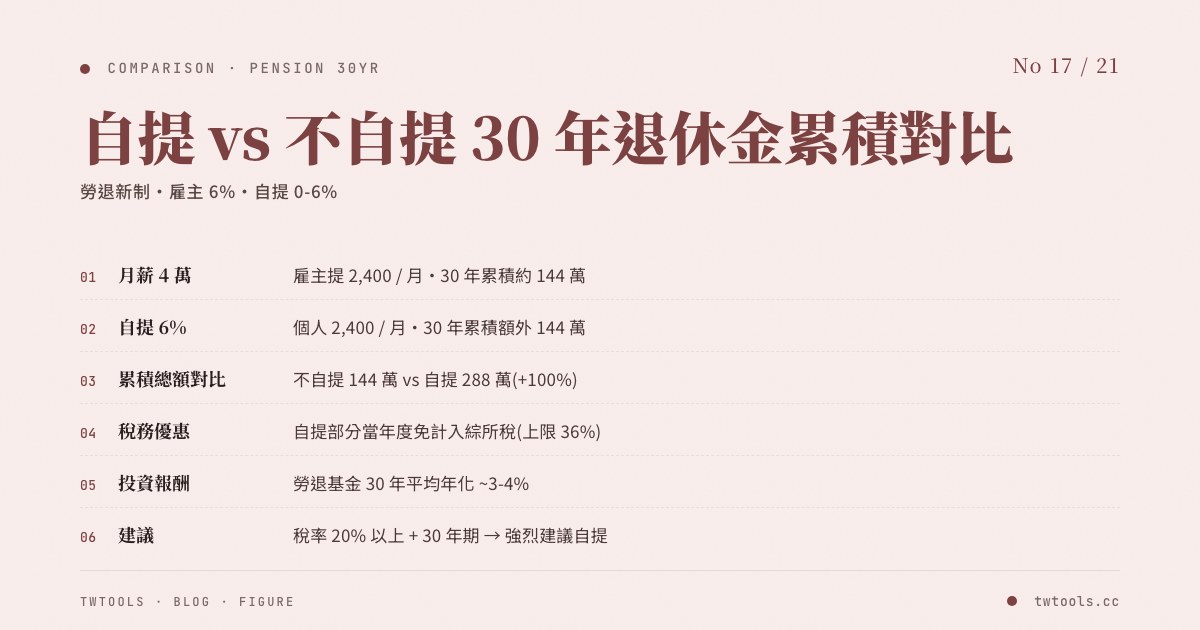
Worked example: 6% voluntary contribution on an NT$40,000 monthly salary
Suppose you earn NT$40,000 a month and voluntarily contribute 6%, or NT$2,400 monthly — NT$28,800 a year. Keep this up for 30 years:
| Annualized return | 30-year accumulated principal and interest |
|---|---|
| 3% | About NT$1.4 million |
| 4% | About NT$1.7 million |
| 5% | About NT$2 million |
This is additional retirement money, counted separately from the employer’s 6% — at retirement, it gives you a separate pool of available cash.
Actual Labor Pension Fund returns in recent years: a long-term annualized average of 4–5% (well above the 1.5–2% on 2-year time deposits). So the realistic accumulated total is closer to “above NT$1.7 million.”
Three big advantages of voluntary contribution: tax savings, forced saving, and a guaranteed floor
A lot of people assume voluntary contribution is just saving your own money — nothing special. In practice, there are three real advantages:
1. The tax savings hit immediately
The voluntary contribution amount is excluded from that year’s taxable salary income. In other words, the money you contribute comes out of your tax base. Here’s the latest 2026 calculation:
| Monthly salary | Annual voluntary contribution | Tax bracket | Annual tax saved |
|---|---|---|---|
| NT$30,000 | NT$21,600 | 5% | NT$1,080 |
| NT$40,000 | NT$28,800 | 12% | NT$3,456 |
| NT$60,000 | NT$43,200 | 12% | NT$5,184 |
| NT$80,000 (single) | NT$57,744 | 12–20% | about NT$5,967 |
| NT$100,000 | NT$72,000 | 20% | NT$14,400 |
| Dual-income couple, NT$150K + NT$120K | NT$108,000 + NT$87,048 | 20% | about NT$32,046 |
⚠️ For a household with monthly salary above NT$80,000, married, with both partners contributing, legal tax savings exceed NT$30,000 a year — over 30 years, the cumulative savings are equivalent to an extra NT$1 million in retirement money.
2. Forced saving
The Labor Pension account can only be drawn at age 60 — no mid-stream withdrawals. For office workers who can’t seem to hold onto savings, this is the most effective “lock-in” mechanism out there: the money comes out on payday before it ever touches your daily account, so it actually gets saved.
3. Guaranteed minimum return
The Labor Pension Fund guarantees a return no lower than the 2-year time deposit rate (in 2026, the 2-year deposit rate at state-owned banks is around 1.5–2%, announced monthly by the Ministry of Labor’s Bureau of Labor Funds). If the fund loses money in a given year, the government makes up the difference. Compared with the risk of investing on your own and taking a loss, that’s a very comfortable floor.
Actual 5-year average return of the Labor Pension Fund: about 4–5%, clearly above the guaranteed floor.
Who should contribute voluntarily? Who shouldn’t?
Good fit for voluntary contribution ✅
- Monthly salary above NT$40,000, in the 12% tax bracket or higher: the tax savings are meaningful
- People who can’t hold onto savings and tend to impulse-spend: the forced-saving effect is strong
- Stable job, no upcoming need for a large sum: you can’t touch it until 60 anyway
- Already have an emergency fund and basic insurance in place: voluntary contribution won’t affect day-to-day quality of life
Not recommended ❌
- Monthly salary below NT$30,000, in the 5% tax bracket: tax savings are limited and cash flow is tight — build the emergency fund to 3 months of living expenses first
- Carrying high-interest debt (revolving credit cards, cash cards): pay it off first. Credit card revolving interest of 7–15% per year (the legal cap is 15%) hurts far more than a 3% pension return can help
- Planning to buy a house, start a business, or get married in the short term: those large expenses will need cash, and money put in here is locked until age 60
Middle ground (start at 3% as a test)
- Monthly salary of NT$50,000–70,000, in the 12% tax bracket
- 1–2 months of emergency fund built but not yet at 6 months
- Low-interest student loans, but nothing at credit card rates
Start at a 3% voluntary contribution to test the waters, then decide six months in whether to raise it to 6%. Easing in gradually doesn’t disrupt your monthly rhythm.
How to apply: the actual steps
The process is simpler than people expect — no trip to the Bureau of Labor Insurance required, just handle it directly through your employer:
- Tell company HR: fill out the “Application Form for Change of Individual Voluntary Labor Pension Contribution Rate”
- Choose your contribution rate: 1%–6% (in 1% increments)
- Effective from the following month: the new contribution rate normally kicks in next month
- Adjustable or stoppable any time: up to two changes per year. If you need cash temporarily, you can drop it to 0%
To estimate how your take-home pay changes after contributing, a unit conversion tool can quickly run the differences across brackets, or a countdown timer can set a cumulative target for your monthly contribution to make the progress visible.
Checking your Labor Pension account and longer-term planning
Three ways to check
- Bureau of Labor Insurance website (log in with your Citizen Digital Certificate or NHI card)
- “Bureau of Labor Insurance e-service” app (mobile verification login)
- In-person at a Bureau of Labor Insurance office (local branches)
Check at least every six months to confirm your employer is actually contributing — that avoids under-payment or missed contributions. If you find the employer should have contributed but hasn’t, you can file a complaint with the Bureau of Labor Insurance (it’s an illegal act by the employer, and the worker’s rights are protected).
Long-term planning
The financial pyramid, from bottom to top:
- Emergency fund (3–6 months of living expenses)
- Pay off high-interest debt (credit cards, cash cards)
- Basic medical and accident insurance
- 6% voluntary Labor Pension contribution (tax savings + guaranteed return + forced saving)
- Active investing (stocks, ETFs, dollar-cost averaging)
Build a 6-month emergency fund and clear high-interest debt first — then start thinking about voluntary contributions. If your finances have room now, start with 3% as a trial, then decide at the six-month mark whether to raise it to 6%.
FAQ
Q1: Can I withdraw the voluntary contributions early?
A: In principle, no. The Labor Pension (new system) rule is that you must be 60 to claim — early withdrawal is allowed only in extreme cases like death, total disability, or loss of contact. If you urgently need cash, the most you can do is stop further voluntary contributions, but the money already contributed still has to wait until 60.
Q2: Will voluntary contribution be interrupted if I change jobs?
A: No. Your Labor Pension individual account is tied to your national ID number, not the company. After changing jobs, re-apply for voluntary contribution at the new employer — the money in the old account stays put and continues to earn returns.
Q3: Does the Labor Pension voluntary contribution conflict with the Labor Insurance old-age annuity?
A: No conflict at all. Labor Pension and Labor Insurance are two separate systems: Labor Insurance pays either a monthly pension or a lump sum, while the Labor Pension (new system) is an individual account. You can receive both, giving you double protection at retirement.
Q4: Can middle-aged or unemployed people still contribute voluntarily?
A: Yes. Self-employed people over 55, workers with no fixed employer, and freelancers can apply for voluntary contribution directly at the Bureau of Labor Insurance. They get the same tax savings and guaranteed return, with the monthly salary based on their insured salary.
Q5: If the Labor Pension Fund loses money, does it cut into my principal?
A: No. Even if the fund posts a loss in a given year, your individual account is not debited — your principal is fully preserved. The government guarantees a return no lower than the 2-year time deposit rate, effectively a “downside guarantee.”
Q6: At 60, do I take it as a lump sum or a monthly payment?
A: You can choose. Lump sum = all the principal and interest paid out at once; monthly = the total divided by your average life expectancy to give a monthly figure. The general guidance: if your retirement income is enough to live on, monthly payments give you inflation protection; if you have a big plan (buying a house, starting a business), the lump sum may suit you better. The Bureau of Labor Insurance website has a calculator to help you compare.
Take action
Start with one thing today: open the Bureau of Labor Insurance app and check the balance in your Labor Pension account. Seeing the actual accumulated number is more motivating than imagining it.
If you decide to contribute, the next time you have a salary discussion with HR, just say “I’d like to apply for 6% voluntary Labor Pension contribution” — it takes 30 seconds to set up. The NT$2,400 you “take less” each month becomes the security of your retirement 30 years from now.