How Much Emergency Fund Do You Need? 2026 Calculation Formula + Best High-Yield Savings for NT$30K-60K Workers

On an NT$30,000–60,000 salary, when your phone suddenly breaks, your scooter needs repairs, a family member is hospitalized, or your company suddenly lays you off — these aren’t questions of if, they’re questions of when. An emergency fund is the money that lets you ride through those events without swiping a credit card or asking family for help.
This guide uses 2026 numbers to lay out: how much to save, where to put it, and how to start saving — with a painless path even for people who have never saved before. Data current as of May 2026.
What is an emergency fund? Why every office worker needs one
The definition is simple: cash that can cover your basic living expenses for 3–6 months even with no income at all. It’s not an investment, not savings insurance, and not money parked in stocks — it’s cash that’s available immediately and can’t lose value.
Why does it matter? According to the Directorate-General of Budget, Accounting and Statistics (DGBAS), the average gap between jobs for Taiwanese employees is about 2–4 months, and for older workers it can stretch beyond half a year. If a layoff hits, illness takes you out, or a family emergency happens, anyone without an emergency fund ends up putting daily life on credit cards and watching the debt snowball grow.
The fund’s job is to preserve your options when things get hard — so you don’t have to take a bad job just to cover next month’s rent.
How much do you actually need? The 3–6 months of expenses formula
The common rule: 3 months if you’re single, 6 months if you have a family. But what counts as “one month of expenses”? Not your monthly salary — it’s the money you absolutely have to spend each month, which usually includes:
- Rent or mortgage
- Utilities (water, electricity, gas) and phone/internet
- Food (at a minimum — eating out or cooking)
- Transportation
- Insurance premiums (NHI, Labor Insurance, life insurance, etc.)
- Fixed monthly loan payments (car loans, student loans)
The total is your minimum cost of living. Don’t count entertainment, clothing budgets, or dining out — all of those can be paused in an emergency.
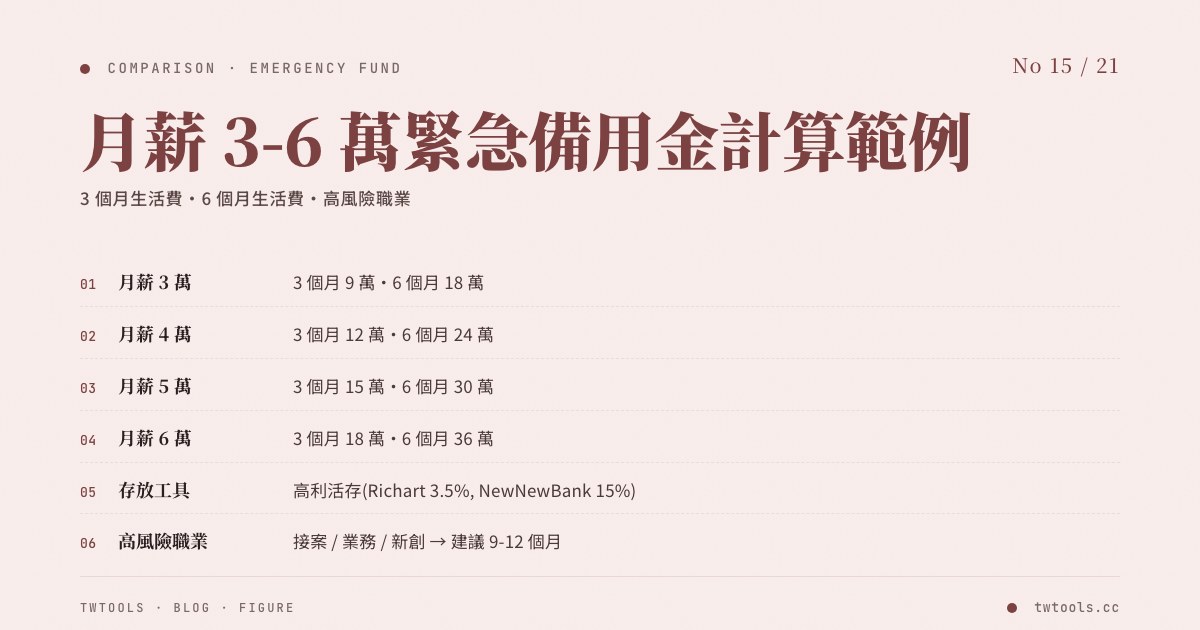
Worked examples for NT$30K–60K salaries
Three typical scenarios:
Example A: NT$30K monthly salary, single, renting
- Rent NT$9,000 + utilities NT$1,500 + food NT$8,000 + transportation NT$2,000 + insurance NT$2,000 = minimum NT$22,500/month
- 3-month fund = NT$67,500
Example B: NT$45K monthly salary, dual-income couple with no kids (individual portion)
- Rent NT$15,000 (NT$7,500 each) + utilities NT$1,500 + food NT$10,000 + transportation NT$3,000 + insurance NT$3,000 = minimum NT$25,000/month
- 3-month fund = NT$75,000
Example C: NT$60K monthly salary, married with kids
- Mortgage NT$25,000 + utilities NT$2,500 + food NT$18,000 + childcare NT$12,000 + transportation NT$4,000 + insurance NT$5,000 = minimum NT$66,500/month
- 6-month fund = NT$399,000
Looks like a lot? In practice, if you auto-transfer half of each month’s leftover cash into the emergency account, most people reach the goal in 1–2 years. The point isn’t “how much you have right now” — it’s whether you’ve started.
Where to keep an emergency fund — safe but not idle: 2026 digital-bank high-yield savings comparison
The core principle: liquidity beats yield. Put the fund in the wrong place and you give up the very thing that makes it useful. Comparison of 2026 mainstream digital bank high-yield savings accounts:
| Bank | Rate | Balance cap | Conditions | Best for |
|---|---|---|---|---|
| Richart (Taishin) | 3.5% | NT$300,000 | New accounts opened after 2026-03-02 | New customers seeking highest rate |
| Richart existing accounts | 1.8% | NT$300,000 | During promotional period | Existing Richart account holders |
| NewNewBank | 15% | NT$100,000 | New accounts only | Short-term high yield on small balances |
| O-Bank | 8.8% | NT$100,000 | New accounts only | Mid-tier balance, high rate |
| Rakuten International Bank | 15% | First 10 days after opening | New accounts only | Very short term |
| SinoPac DAWHO | 1.5% | NT$300,000 | Interest accrued monthly | Stable, no thresholds |
| NEXT Bank | 2% on first NT$200K / 1.5% above NT$50K, no cap | No new-account requirement | Large balances, long-term | |
| Chunghwa Post passbook savings | 0.6% | No cap | None | Users uncomfortable with digital banks |
| Standard bank passbook savings | 0.05–0.2% | No cap | None | ⛔ Not recommended |
⚠️ 2026 rate movements: every bank adjusts rates roughly every six months — the table above reflects Q2 2026. Review once a year (early in the year is a good cadence) to see who’s competitive.
Recommended portfolio (spread the risk)
- Under NT$300,000: place it all in Richart (new account) at 3.5%, or NEXT Bank at 2% if you can’t open Richart
- NT$300,000–500,000: NT$300,000 in Richart + NT$100,000 in NewNewBank or O-Bank (high yield) + remainder in SinoPac DAWHO or NEXT Bank
- NT$500,000+: NT$300,000 in Richart at 3.5% + NT$300,000 each in SinoPac DAWHO and NEXT Bank at 1.5–2% (diversification)
What to avoid ⛔
- Stocks, ETFs, mutual funds: prices can drop or get locked up at exactly the moment you need the cash
- Cryptocurrency: too volatile — totally unsuitable as an emergency fund
- Savings insurance: early surrender costs you 10–30% of principal, and liquidity is terrible
- Long-term time deposits: early termination forfeits interest
Starting from zero: a 3-step painless plan
Month 1: nail down your real monthly expenses
Pull the last 3 months of credit card statements and EasyCard records, categorize and total them, and figure out your average monthly necessary expenses. Use Excel or a budgeting app (MoneyGo, CWMoney, AndroMoney) for the categorization.
Month 2: open a dedicated account
Open a separate emergency fund account at a digital bank, kept apart from your salary account so you’re not constantly seeing it. Richart, SinoPac, NEXT Bank, and O-Bank all let you open online in 5–10 minutes — no branch visit needed.
Month 3 onward: set up auto-transfer
On every payday, automatically move 10–20% of your salary into that account until you hit the 3-month or 6-month target.
To work out how many months it’ll take you to hit the target, use the Date Calculator to work backward from a target date and pair it with the Countdown Timer to track progress — it’s easier to stay consistent than relying on willpower alone.
Common misconceptions: don’t count these as an emergency fund
A lot of people assume the following count as a safety net and only discover they don’t when it’s too late:
- Credit card credit limit: this is debt, not savings. Paying emergency expenses with credit just amplifies next month’s cash crunch. Credit card revolving interest rates of 7–15% (15% is the legal ceiling) pull you deeper into debt
- Savings insurance: early surrender loses principal, and liquidity is terrible
- Stocks and funds: a forced sale in a bad market locks in real losses
- Promises to lend from family or friends: when you actually need money, those promises may not materialize
- Expected year-end bonuses: in a bad economy these can shrink or get cancelled outright — not a stable source
FAQ
Q1: My emergency fund hits 6 months. Should I keep saving into it?
A: No. Once you’ve hit the target, additional money can move toward investments (stocks, ETFs, Labor Pension voluntary contributions, etc.) for higher returns. The emergency fund’s role is defense, not offense — overstuffing it costs you opportunity. Review the target each year and adjust to your living expenses.
Q2: Do people with mortgages need a bigger fund?
A: Yes. A mortgage is a fixed, uninterruptible expense, so anyone with a mortgage should aim for at least 6 months of living expenses plus the mortgage payment as the target. If the household is on a single income, push that to 9–12 months — losing the income shouldn’t mean defaulting on the mortgage at the same time.
Q3: Can I dip into the emergency fund to pay credit card bills or invest?
A: Strongly not recommended. The moment the fund gets used for anything that isn’t a real emergency, it loses its insurance function. If you want money to invest, separate a third “investment account” from your salary — keep it completely separate from the emergency fund.
Q4: Can I invest at the same time I’m building the fund?
A: Yes, but the order matters. Save at least one month of emergency fund and pay down any high-interest debt first, then start small periodic investments (for example, NT$3,000 a month into an ETF). Running both in parallel keeps the habit alive, but it shouldn’t crowd out your day-to-day quality of life.
Q5: Is NewNewBank’s 15% real? What’s the catch?
A: It’s real, but limited: ① new accounts only, ② balance cap of NT$100,000, and ③ usually a “promotional period” of 3–6 months. So don’t dump your whole emergency fund into it as a long-term plan — it works as a “ride the high rate first, move it to a long-term home before the promotion ends” play.
Q6: Richart’s 3.5% is new-account-only. What if I already have Richart?
A: Existing Richart accounts get 1.8% on the first NT$300,000 (first half of 2026), which is still solid among savings accounts. If you’ve never opened Richart, opening one now and capturing the 3.5% first-year rate is worth it — the annual interest difference is NT$300,000 × (3.5% − 1.8%) = NT$5,100/year.
Q7: Isn’t spreading money across multiple banks a hassle?
A: Not really. Every bank app is solid, and auto-transfer setup is a one-time job. You’ll only touch it 1–2 times per year (refreshing new/existing-customer rates and reviewing at year-start). For an extra 1–2% on the rate, it’s worth the 30 minutes.
Take action now
The first thing you can do today: open your salary account app, look at the balance, calculate how far you are from a 3-month fund, and set up an auto-transfer starting tomorrow into a dedicated account.
Having a real number to aim at is 10× more effective than vaguely thinking “I should save money.” If you don’t have a digital bank account yet, spend 10 minutes tonight opening Richart or NEXT Bank, set up the auto-debit, and start building your safety net from the next payday onward.