2026 Currency Exchange Guide: 6 Channels, Fees, Airport & ATM Reality in Taiwan

Traveling abroad, studying overseas, shopping across borders — currency exchange is one of those tasks you can’t skip. But for the same US$1,000 exchange need, the cost can swing by NT$800 to NT$2,000 depending on which channel you use and when. This 2026 update walks through the real cost of all 6 main exchange channels — from rate types to fee structures, all the way to the 1.5% foreign transaction fee and the DCC trap — so you can pick the right method every time.
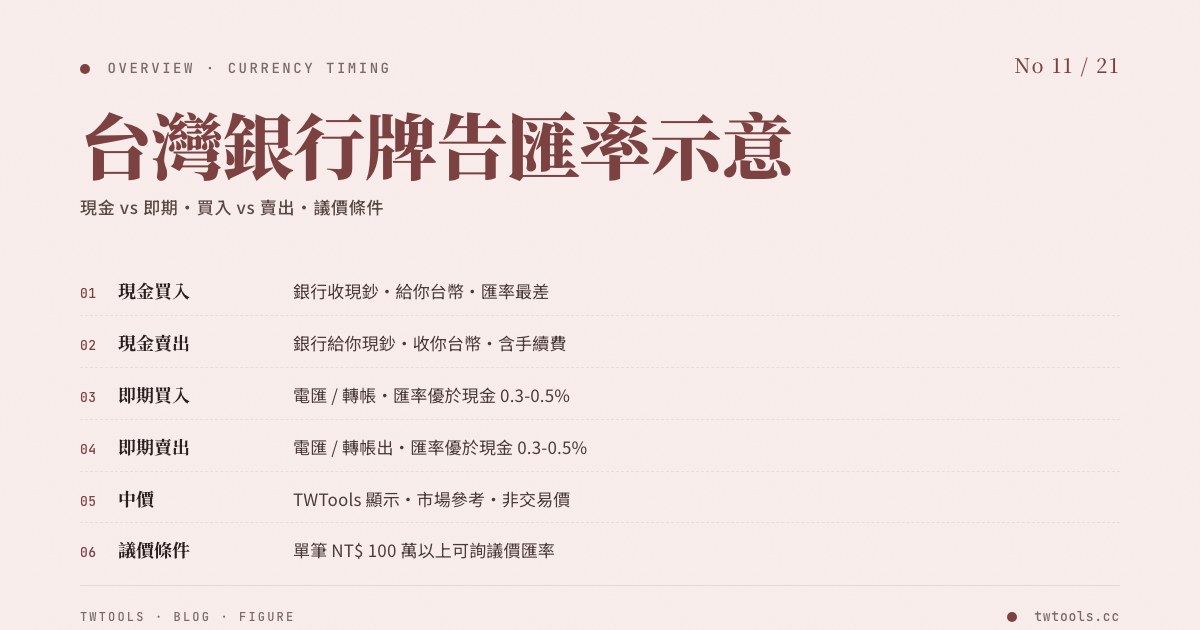
1. Reading exchange rate quotes: spot, cash, buy, sell
Open any bank’s posted exchange rate page and you’ll see four columns of numbers. Sorting out these four terms first makes every comparison that follows easier.
Spot rate: used for transfers between foreign-currency accounts, online forex settlement, and overseas credit card billing. No physical cash changes hands, the bank’s operating cost is lower, and the rate is the most favorable for customers.
Cash rate: used for buying and selling physical banknotes. The bank has to import, store, and count cash, so the operating cost is higher and the rate is worse than spot.
Buying rate: the price at which the bank buys foreign currency from you — this is the column you read when you’re converting foreign currency to NTD.
Selling rate: the price at which the bank sells foreign currency to you — this is the column you read when you’re converting NTD to foreign currency.
In practice, the spot rate beats the cash rate by 0.5%–1.5% depending on the currency. For US dollars, the gap between spot-sell and cash-sell during the first half of 2026 was roughly NT$0.30 per US$ — about NT$300 difference on a US$1,000 exchange. The gap is wider for Japanese yen: a common NT$0.04 per JPY adds up to about NT$400 difference on a JPY 100,000 exchange.
Bottom line: use spot whenever you can. But you’ll still need cash for things on the ground when traveling — that’s where picking the right exchange channel below makes the difference.
2. Real cost comparison across 6 exchange channels (2026 update)
| Channel | Rate type | Fee | Rating | Best for |
|---|---|---|---|---|
| ① Online forex settlement (Mega / Bank of Taiwan) | Spot | NT$0 | ★★★★★ | Planning 2+ weeks before departure |
| ② Bank app currency exchange | Spot | NT$0 | ★★★★★ | Holding foreign currency in an account for later use |
| ③ Bank counter | Cash | About NT$100 per transaction | ★★★ | Need cash urgently, or confirming a large transaction in person |
| ④ Foreign currency ATM (debited from NTD account) | Cash rate posted by each bank + NT$5 cross-bank fee | NT$5 cross-bank + bank’s preferential rate | ★★★★ | Small cash needed now, 24/7 |
| ⑤ Airport bank counter | Cash | NT$0 for NTD-to-foreign-currency | ★★★ | Day-of-departure last minute |
| ⑥ Local ATM withdrawal overseas | Spot + overseas withdrawal fee | NT$75–150 per transaction + local ATM fee | ★★★ | Topping up cash mid-trip |
① Online forex settlement (the most cost-effective legal channel)
Both Mega Bank and Bank of Taiwan offer 24/7 online forex settlement: log in to online banking, fill out the order, pick a branch for pickup, and collect the cash at that branch (or the airport) within 7 working days. Spot rate + zero fee + no queueing — ideal for anyone planning at least 2 weeks before departure. Major currencies including JPY, USD, EUR, and CNY are all supported.
② Bank app spot exchange
Many banks (Taishin, E.SUN, Cathay United, SinoPac, and others) offer 24/7 in-app currency exchange. You move money directly from your NTD account to a foreign-currency account at the same bank, at the spot rate with no fee. The foreign currency stays in the account for online spending, or you can pick it up as cash at a branch before traveling.
③ Bank counter
The traditional channel. The rate uses “cash sell,” which is less favorable, and some banks charge a fee of around NT$100 per transaction. The upside: large amounts (over NT$500,000) get double-checked in person, and you can handle travel checks or overseas wire transfers in the same visit.
④ Foreign currency ATM (in Taiwan)
Debits your NTD account directly and dispenses foreign-currency cash. The rate follows each bank’s posted cash rate (some banks offer a small discount), and the cross-bank fee is just NT$5. Example: E.SUN debits the NTD account at the cash posted rate, with an extra NT$0.05 per US$ and NT$0.001 per JPY.
Withdrawing from a foreign-currency account uses a different formula: Mega charges a flat NT$100 per transaction; Taishin moved to “(spot rate − cash rate) × 0.5” with a NT$100 minimum starting 2025-06-06; E.SUN uses “foreign-currency amount × rate spread × 0.9” with a NT$100 minimum.
⑤ Airport bank counters and cash exchange machines
Both Terminal 1 and Terminal 2 at Taoyuan Airport have Bank of Taiwan and Mega counters open 24/7. Zero fee for NTD-to-foreign-currency (per both banks’ policies), but the rate uses “cash sell” and is slightly worse than at city branches (because 24/7 staffing and traveler urgency both cost money).
Taoyuan Airport added “foreign currency banknote exchange machines” in 2024. No fee for exchanging banknotes, and the rate matches the bank’s posted rate — a great backup plan if you forgot to exchange money before heading out. Just note: each machine only accepts certain denominations, and change handling varies by machine.
⑥ Local ATM withdrawal overseas
ATM cards with the PLUS or Cirrus logo can withdraw local currency at overseas ATMs. The rate is close to spot (set by the international card network), but every withdrawal costs you a Taiwan-side overseas withdrawal fee of NT$75–150 plus a local ATM fee (about JPY 220 at a Japanese 7-Eleven ATM, about US$3–5 at most US banks). It’s cost-effective for larger withdrawals (over NT$5,000), and least efficient when you make many small ones.
3. Overseas card vs cash: the real cost math
People often agonize over whether to pay by card or use cash abroad. Start with how the credit card cost works:
Total cost of overseas card use = international network conversion (close to spot rate) + 1.5% foreign transaction fee
The three major networks — VISA, Mastercard, and JCB — charge a uniform 1.5% through Taiwanese banks (1% from the network itself + up to 0.5% allowed by the FSC for the bank to add on top), and American Express charges 2%. The 1.5% is already baked into the statement amount, not charged separately.
Worked example: buying JPY 100,000 of merchandise in Japan
- Method A: exchange JPY 100,000 in cash through online forex settlement in Taiwan first: spot rate + zero fee — assuming an exchange of 0.218, the cost is about NT$21,800
- Method B: pay by card overseas: card billed at spot (also around 0.218) + 1.5% fee — cost is about NT$22,127 (NT$327 more)
- Method C: airport cash counter: cash-sell rate of 0.221 + zero fee — cost about NT$22,100
- Method D: withdraw JPY 100,000 from a Japanese ATM: spot 0.218 + Taiwan-side overseas withdrawal fee NT$100 + Japanese ATM fee JPY 220 (about NT$48) — cost about NT$21,948
Conclusion: online forex settlement (Method A) is the cheapest. Once on-the-ground cash runs out, overseas card payment (Method B) actually beats exchanging cash at the airport (Method C). ATM withdrawal (Method D) makes sense as an emergency top-up during the trip, but it’s not the right way to get all your cash at the start.
The DCC trap: when the cashier asks “NTD or local currency?”
DCC (Dynamic Currency Conversion) is the service overseas merchants and ATMs use to ask whether you’d like the amount “displayed in NTD.” Always choose local currency. DCC uses the merchant’s own exchange rate, which is typically 3%–7% worse than the network rate, and your 1.5% foreign transaction fee still applies on top — a double markup.
The hidden definition of “overseas spending”
“Overseas spending” isn’t just swiping a card while physically abroad. Netflix, Spotify, Disney+, Apple One, Uber Eats, Foodpanda, ChatGPT Plus, and similar subscriptions all count as overseas spending, and each transaction picks up the 1.5% fee. A common move: consolidate these subscriptions onto a card with strong overseas rewards (SinoPac OctoCard, Taishin Richart, Far Eastern HAPPY+, HSBC Cashback, and others) so the 1.5% gets offset or even flipped into a small gain.
4. Timing your exchange
Large exchanges: split them up
If you’re exchanging foreign currency worth more than NT$500,000, split it into 3–5 transactions spread across 1–2 months to avoid the risk of buying at a single bad moment. Currencies typically swing 5%–10% within a year, and spreading purchases pulls you closer to the average.
Watch central bank announcements and rate differentials
NTD vs USD is driven mainly by the US Dollar Index (DXY), the Taiwan–US interest rate gap, and US dollar demand from exporters. Volatility runs high around Fed rate-decision weeks, so it can pay to wait 2–3 days after the meeting to see the direction before pulling the trigger.
Set a price alert
TWTools’ exchange rate tool shows real-time posted rates. Pair it with mobile notifications: set a target rate and act on it when the rate hits.
5. Exchange habits for popular travel currencies
Japanese yen (JPY): relatively volatile — spreading online forex settlements across the 2 weeks before departure is more stable. Big stores and convenience stores in Japan accept card payment, but rural shops, shrines, and street stalls often still need cash.
US dollar (USD): parts of Southeast Asia and Central/South America also accept US dollar cash. Carry small denominations (US$1, 5, 10) for easier change.
Hong Kong dollar (HKD): most places in Hong Kong run on cards and digital payments — HK$1,000–2,000 in cash is plenty.
Korean won (KRW): South Korea has near-universal card acceptance (even night-market stalls take T-money). Exchanging just KRW 50,000–100,000 for tips and emergencies is enough.
Euro (EUR) and British pound (GBP): easy to use, but stick to 5/10/20 denominations in cash — many shops refuse 100/200 notes.
Renminbi (CNY): in mainland China, WeChat Pay and Alipay dominate and cash barely circulates — a small backup amount is enough.
6. FAQ
Q1: Why is the spot rate better than the cash rate?
Spot is a numeric transfer between accounts, with no physical banknote handover — banks don’t carry the storage, transport, or counting costs. The cash rate bakes in those handling costs, which is why it runs 0.5%–1.5% worse than spot.
Q2: Are the banknotes from online forex settlement new or used?
It depends on the bank. Most don’t guarantee crisp new bills but will give you notes “fit for circulation” (no damage or stains). For gift-giving or pristine notes specifically, request them at the counter at a branch.
Q3: Are the airport cash exchange machines reliable?
The foreign-currency banknote exchange machines at Taoyuan Airport are installed by banks. Rates match the bank’s posted board, and there’s no fee for the exchange — a solid 24/7 backup plan. Just remember: the machines accept only certain denominations and may not give change, so read the on-machine instructions before using them.
Q4: Is an overseas-rewards credit card worth applying for?
If your monthly overseas card spending plus overseas subscriptions exceeds NT$5,000, a card offering 3% or better rewards on overseas spending fully offsets the 1.5% fee — and you may even come out ahead. Below that threshold, the management overhead of an extra card usually isn’t worth it.
Q5: Does the 1.5% fee still apply if I selected local currency to avoid DCC?
Yes — the 1.5% fee is charged on the “cross-border card transaction” itself (1% from the network + 0.5% from the bank). But you’ve avoided the extra 3%–7% inflated DCC rate, so you still come out ahead overall.
Conclusion
Taiwan has more currency exchange options in 2026 than ever before: online forex settlement (Mega / Bank of Taiwan, zero fee + spot rate) is the first choice; foreign currency ATMs work for 24/7 small cash needs; airport cash exchange machines are the day-of-departure backup; and paying by card overseas with the right rewards card can wipe out the 1.5% fee completely.
The more you understand currency exchange, the more you save — and not just on “fees.” A 10-day trip to Japan and 10 cross-border subscriptions over a year add up to several bowls of ramen in savings. Next time before a trip, open TWTools’ exchange rate tool, glance at Bank of Taiwan’s posted board, and pick your channel from there. Those 5 minutes of homework are worth more than you’d think.
Further reading: 2026 Complete Guide to Japan Travel: Visas, Transportation, Must-See Spots and Useful Apps — covering JPY exchange timing, JR Pass fare calculations, and local connectivity options.